


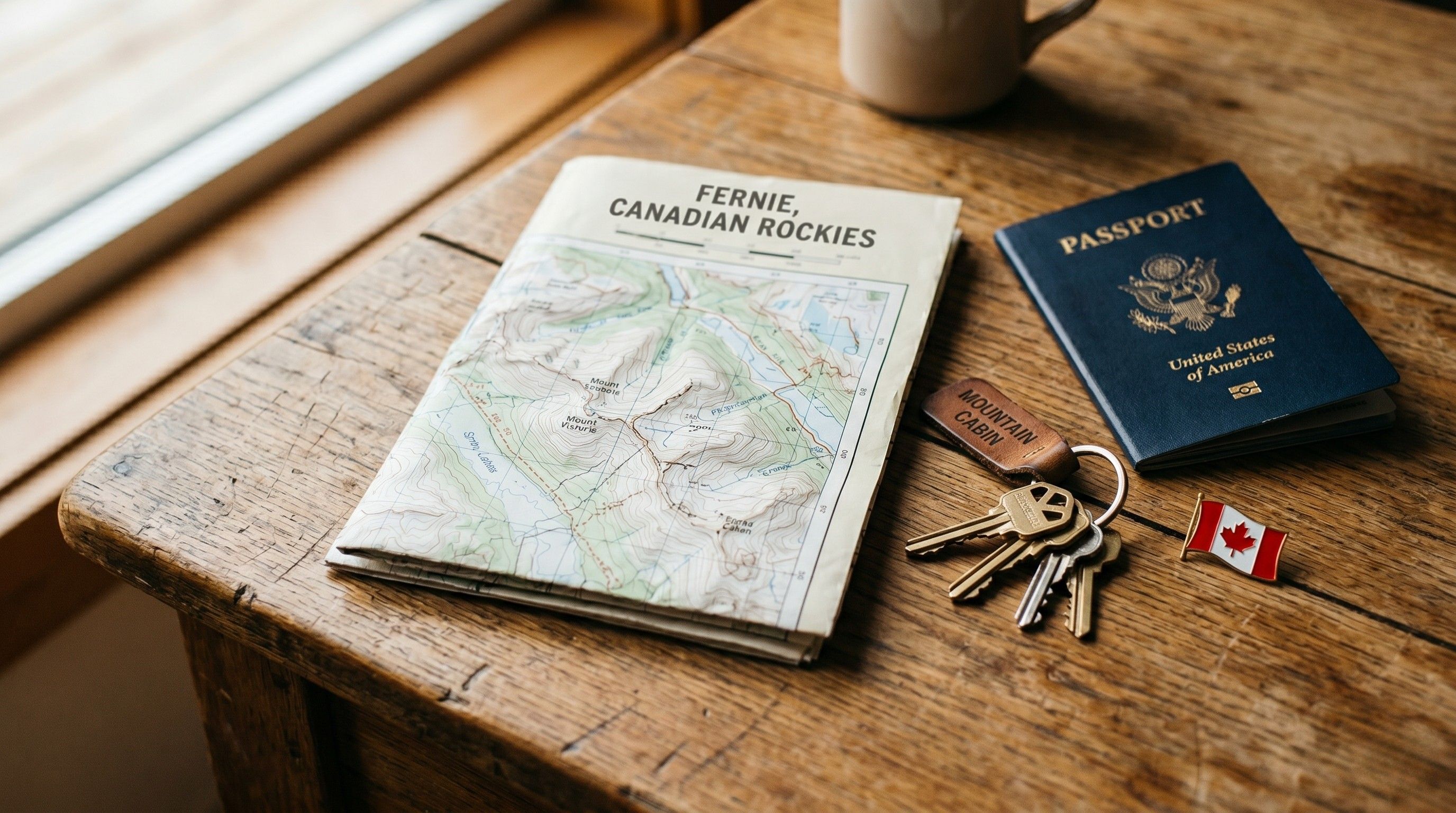
I’ve had more conversations with American buyers in the last 18 months than at any other point in my career. Some found Fernie through ski trips. Some came through friends who had already made the move. A few simply typed “mountain town real estate Canada” into Google one evening and ended up on the phone with me.
The reasons they’re looking are different for everyone. But there are a few things that keep coming up, and if you’re a US buyer exploring options, this one’s for you.
The Exchange Rate Still Works in Your Favour
Right now, one US dollar buys roughly 1.37 Canadian dollars. That’s not a once-in-a-generation anomaly, it’s where the rate has been sitting for a while, and it has a real effect on what your money can do here.
On a $750,000 CAD property (an average property price in Fernie), you’re spending approximately $550,000 USD. For buyers coming from US markets, those numbers represent a very different reality than what they’d find at home for the same quality of mountain lifestyle.
The exchange rate alone doesn’t make a deal. But it does make Fernie worth looking at seriously when you run the numbers.
Fernie Isn’t Affected by the Foreign Buyer Ban
Canada introduced a foreign buyer ban in 2023, which restricts non-Canadians from purchasing residential property in many parts of the country. A lot of American buyers hear about this and assume it applies everywhere.
It doesn’t apply to Fernie.
The ban targets areas classified by Statistics Canada as a Census Metropolitan Area or Census Agglomeration. Fernie isn’t one of them. Neither is most of the East Kootenay region. That means American buyers can purchase property here without the restrictions that apply in places like Vancouver, Victoria, or Kelowna.
This is one of the most important things to understand if you’re comparing markets across BC. Fernie sits in a different category.
What You Need to Know as a US Buyer
Non-Resident Speculation Tax: BC charges a 20% Non-Resident Speculation Tax (NRST) on property purchases by foreign nationals in certain regions of the province. Check with a BC real estate lawyer on whether and how this applies to your specific situation in the East Kootenay.
Down payment: Most Canadian lenders require non-residents to put down 35% or more. Some US buyers work with cross-border lenders or use cash and home equity to bridge this. It’s worth a conversation with a mortgage broker who handles cross-border files.
Legal support: You’ll want a BC-licensed real estate lawyer in your corner. The paperwork and process are similar to what you’d find in the US but not identical, and having proper representation matters.
Tax on rental income: If you plan to rent the property while you’re not using it, there are Canadian tax implications. A cross-border accountant can walk you through what’s required.
I’m not a lawyer or a tax advisor, and this post isn’t legal or financial advice. What I can do is connect you with the right people and make sure you understand what you’re getting into before you make any decisions.
Why Fernie Specifically
This is the part that doesn’t show up in a spreadsheet.
Fernie isn’t trying to be Whistler. It isn’t a manufactured resort experience. It’s a real town of about 5,500 people with a working main street, a strong community, and ski terrain that has been quietly earned a reputation as one of the best in North America.
Fernie Alpine Resort consistently ranks among the top ski destinations in BC. The snowfall is extraordinary as the Lizard Range catches weather systems in a way that dumps serious powder. And unlike some of the bigger resort markets, you can still find properties here at a price point that makes sense.
Beyond ski season, the Elk Valley has world-class mountain biking, the Elk River for fishing and floating, and a four-season lifestyle that keeps people here year-round, not just on weekends.
American buyers who come here often say the same thing: “It feels like Colorado or Montana did 20 years ago.” That’s not a knock on what those places became. It’s an acknowledgment of what Fernie still is.
What the Buying Process Looks Like
The process of buying in BC as a US citizen is more accessible than most people expect. A few things to know:
You don’t need to be in Canada to complete the purchase. Remote transactions with proper legal representation are common, particularly for vacation and investment properties.
The offer process in BC uses standardized contracts through the BC Real Estate Association. Conditions (what you’d call contingencies in the US) are common and give you time to arrange financing, complete an inspection, and review documents.
The timeline from accepted offer to completion is typically 30 to 60 days, though this varies.
If you’re thinking about short-term rental income, Fernie allows STRs within the town limits under a licensing framework. I can walk you through what’s currently permitted and where the best opportunities are.
The Conversation Worth Having
The most satisfied buyers are the ones who did their homework, asked the hard questions upfront, and took the time to understand what they were buying into beyond the property itself.
If you’re an American buyer exploring Fernie, I’m happy to have that conversation with you. No pressure, no pitch. Just honest information about what the market looks like, what the process involves, and whether it makes sense for you.
Reach out directly at phil@philgadd.com or 778-745-0347.
ABOUT THE AUTHOR
Phil Gadd is the owner of First Tracks Real Estate Group, operating under eXp Realty in Fernie, BC. With deep local knowledge and a client-first approach, Phil helps buyers and sellers across Fernie, Sparwood, Jaffray, and Lake Koocanusa find their perfect mountain property. 72 five-star Google reviews. livinginfernie.com