


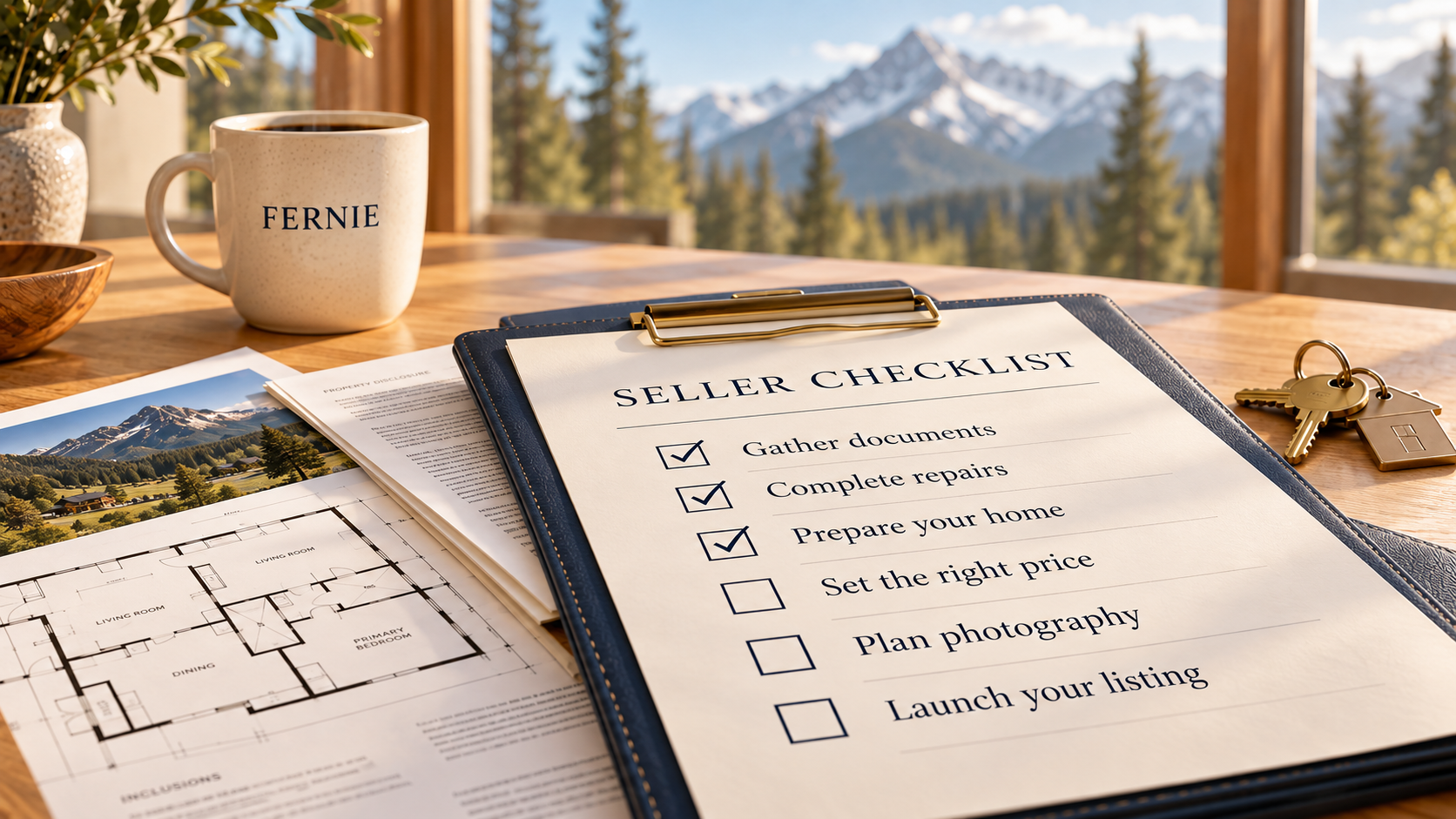
 The short answer
The strongest Fernie sale starts before the listing goes live: resolve permit and disclosure questions, address obvious issues or maintenance concerns, prepare documents, price against the correct market segment and launch with complete photography and a clear property story. The first weeks matter, and accuracy matters more than manufactured urgency.
Fernie buyers are not only comparing bedrooms and square footage. They are comparing location, existing systems, storage, potential issues, renovation quality, rental legality, strata health, views and proximity to amenities. Good preparation makes those advantages easy to verify.
The six-stage Fernie selling plan
| Stage | Seller priority |
|---|---|
| 1. Diagnose | Identify the likely buyer and the property’s real competition. |
| 2. Document | Gather permits, invoices, disclosure, strata or rental records. |
| 3. Repair | Fix confidence-killing defects and complete unfinished work. |
| 4. Present | Clean, simplify, stage and photograph for the season. |
| 5. Price | Use relevant sold and competing evidence, not a town-wide square foot average. |
| 6. Launch | Coordinate access, marketing, responses and offer review. |
Prepare the paperwork before the photos
Buyers lose confidence when basic answers arrive late. Gather property-tax information, utility costs, renovation permits, warranties, surveys, leases, rental records and invoices for major work. Strata sellers should order current documents early. Resort or income-property sellers should assemble management agreements and GST information for professional review.
Disclose known material latent defects
BCFSA explains that sellers have a common-law duty to disclose latent defects that cannot be found through reasonable inspection and make the property dangerous, unfit for habitation or unfit for a known intended purpose. Licensees have broader disclosure duties, including certain defects involving great expense, local-authority notices and missing appropriate permits.
A Property Disclosure Statement is a common way to provide information, but it is not a substitute for legal advice. Be accurate and update information if conditions change. Concealment is not a marketing strategy.
Repairs that protect buyer confidence
In Fernie, small signs of water or winter neglect can make buyers fear a much larger problem. Prioritize active leaks, drainage, damaged roofs or flashing, heating reliability, unsafe stairs or decks, broken windows and unfinished permitted work. Keep invoices and reports.
Cosmetic work should support the property rather than disguise it. Fresh paint, lighting and decluttering can help, but sensible buyers will still ask about the roof, foundation, mechanical systems and snow management.
Price within the right market segment
A downtown heritage home, Ridgemont condo, Montane townhome and ski-hill unit are not interchangeable. Use recent relevant sales, current competitors, condition and buyer demand. In a small market, one unique sale can distort the average.
The list price should create a credible path to market value. Starting too high can reduce early attention and leave the property competing against newer listings after price reductions.
Market the Fernie-specific value
- Show parking, garages, ski and bike storage clearly.
- Explain legal suites or rental permissions with evidence.
- Photograph views accurately and identify orientation.
- Show winter access, driveway grade and snow storage.
- Describe trail, downtown and resort access without exaggerating.
- Include floor plans and practical room dimensions where available.
Compare offers beyond price
When you receive an offer, review deposit, financing, inspection, document conditions, dates, included items and the buyer’s ability to complete. A slightly higher offer with unresolved financing or unsuitable dates may not be the strongest offer. Your real estate professional should explain the risks and let you choose.
Frequently asked questions
When is the best time to sell in Fernie?
There is no universal answer. Spring and summer can show yards and access well, while ski-season buyers may be highly motivated. Inventory, property type and your readiness often matter more than the calendar.
Should I renovate before selling?
Complete repairs that reduce uncertainty first. A major renovation should be supported by likely market return, permits, contractor availability and your timing.
Do I have to complete a Property Disclosure Statement?
BCFSA describes it as a common voluntary disclosure form, while known material latent defects must always be disclosed. Get advice on your specific obligations.
How long does it take to sell a Fernie home?
It varies by price, property type, condition, season and competition. A realistic pricing and launch plan is more useful than a town-wide average days-on-market figure.
The bottom line
The best Fernie real estate decisions are made property by property. Rules, documents, condition and location matter more than a broad label or an optimistic online estimate.
If you want a clear, local assessment before you buy or sell, call or text me at 778-745-0347 or email phil@philgadd.com. I will help you identify the questions that matter before they become expensive.
Phil Gadd is the owner of First Tracks Real Estate Group, operating under eXp Realty in Fernie, BC. Phil has lived in Fernie for 17 years and has sold real estate in the Elk Valley for eight years, helping buyers and sellers across Fernie, Sparwood, Jaffray and Lake Koocanusa.