Fernie, Ski Hill, Sparwood, Tie & Rosen Lakes, South Country & Koocanusa Real Estate and Community News

June 25, 2026

How to Sell Your Fernie Home: What Actually Moves Property Here

I've been selling real estate in Fernie for 8 years. In that time I've listed everything from entry-level condos in Ridgemont to custom built homes in Montane, and the lessons about what works and what doesn't have been pretty consistent across all of them.

Fernie is not a generic market. The buyers here have often been researching it for months before they pick up the phone. They know what comparable homes have sold for. They know which neighbourhoods are better than others. Selling here well requires understanding who those buyers are and what they're looking for - not just putting a sign in the yard.

Here's what I tell every seller before we start.

Pricing Right on Day One Is Not Optional

The biggest mistake I see in this market - and it happens more than you'd think - is pricing optimistically and planning to adjust if needed. That strategy doesn't work in Fernie the way some sellers hope it will.

Buyers here are informed. When a property is priced above market, they notice, and they move on. The listing accumulates days on market and starts to carry a stigma - even after a price reduction, buyers want to know why it sat. The negotiating dynamics shift away from the seller the moment a property looks stale.

In a market where homes are currently selling at approximately 98% of asking price, that number is built on correctly priced listings. The ones that went through price reductions aren't in that stat in a flattering way.

I do a detailed comparative market analysis for every listing before we set a price - not a rough estimate, a proper review of what has actually sold recently, in what condition, in what neighbourhood, and at what price per square foot. That's the foundation.

The Preparation Work Matters More Than Sellers Expect

There's a version of home selling that goes: it's a good market, buyers will see past a few things. That's sometimes true in exceptional markets. Fernie in 2021 and 2022 was one of those markets. Today it isn't.

The properties moving fastest and for the best prices right now are the ones that show well. Fresh paint, good landscaping, decluttered interiors, a clearly well-maintained property - all of this affects both how quickly a property sells and what buyers are willing to pay.

I'm direct with sellers about this because it's in their interest. Spending $3,000 on paint and professional cleaning before listing almost always comes back multiple times in a better final sale price. What you skip in preparation often comes back as a credit negotiation after inspection.

Photography Is the First Showing

Every buyer who ends up standing in your home started by looking at photos online. If those photos are dark, shot at bad angles, or don't show the property at its best, buyers self-select out before they ever call for a showing.

Professional photography is non-negotiable on my listings. For properties where it makes sense, drone photography of the surrounding mountain views and neighbourhood context adds real value. In Fernie, where buyers are often making a lifestyle purchase, showing what's outside the home matters as much as what's inside.

Timing — the Fall Market Is Underrated

Summer is when most people think about selling, and there's a logic to it. The mountain looks its best, the town is busy, photos are easy to take. But I've found consistently that the fall market in Fernie is underestimated.

September and October bring back buyers who didn't find what they wanted in spring and summer. They come with real motivation - if they're going to be in for ski season, they need to close by a certain point. The fall market often has fewer competing listings and more committed buyers than summer, which creates good selling conditions.

If you're thinking about listing but not ready to move until later in the year, a fall launch after a summer of preparation is a strategy worth considering seriously.

Understanding Your Buyer

Most Fernie buyers right now are not first-time buyers in the traditional sense. They're semi-relocators from Alberta, investors with a lifestyle bent, American buyers taking advantage of the exchange rate, or people making a permanent move who've done their research.

They are not impulse buyers. That means the way a property is presented and marketed matters. The copy should speak to why someone would want to live in Fernie, not just describe the house. The marketing needs to reach people outside the immediate area as the buyer for your home probably doesn't live in Fernie yet.

My marketing for every listing includes professional photography, proper MLS distribution, targeted social media promotion, and outreach to my network of buyers who are actively looking. The goal is to get the right buyers in front of your property, not just every buyer.

What I Bring to the Table

I've sold properties in Fernie across every market condition this town has seen over the past 8 years. Every one of those transactions has taught me something about how this specific market works: which neighbourhoods command premiums, which property types attract the most interest, what buyers will negotiate on and what they won't.

If you're thinking about selling, whether in the next three months or in a year, I'd rather have that conversation early. The prep work matters, and the earlier we start, the better positioned you are.

Selling well in Fernie is not complicated, but it does require the right preparation and the right pricing from day one. The sellers who do those two things correctly almost always get a good result.

Reach out anytime at (778) 745-0347 or phil@philgadd.com - I'm always happy to have the conversation early, even if you're not thinking about listing for a while.

Phil Gadd is the owner of First Tracks Real Estate Group, operating under eXp Realty in Fernie, BC. With deep local knowledge and a client-first approach, Phil helps buyers and sellers across Fernie, Sparwood, Jaffray, and Lake Koocanusa find their perfect property. 72 five-star Google reviews. livinginfernie.com | 778-745-0347
Posted in Selling Your Home
June 17, 2026

Lake Koocanusa: What Buyers Need to Know

I've been selling property around Lake Koocanusa for years, and that area never stops surprising people in the best way. The colour of the water on a clear July afternoon is something you don't expect, or the stillness and quiet in the early mornings. But buyers can also be caught off guard, so here's a run down of what you need to know before buying property at Lake Koocanusa.

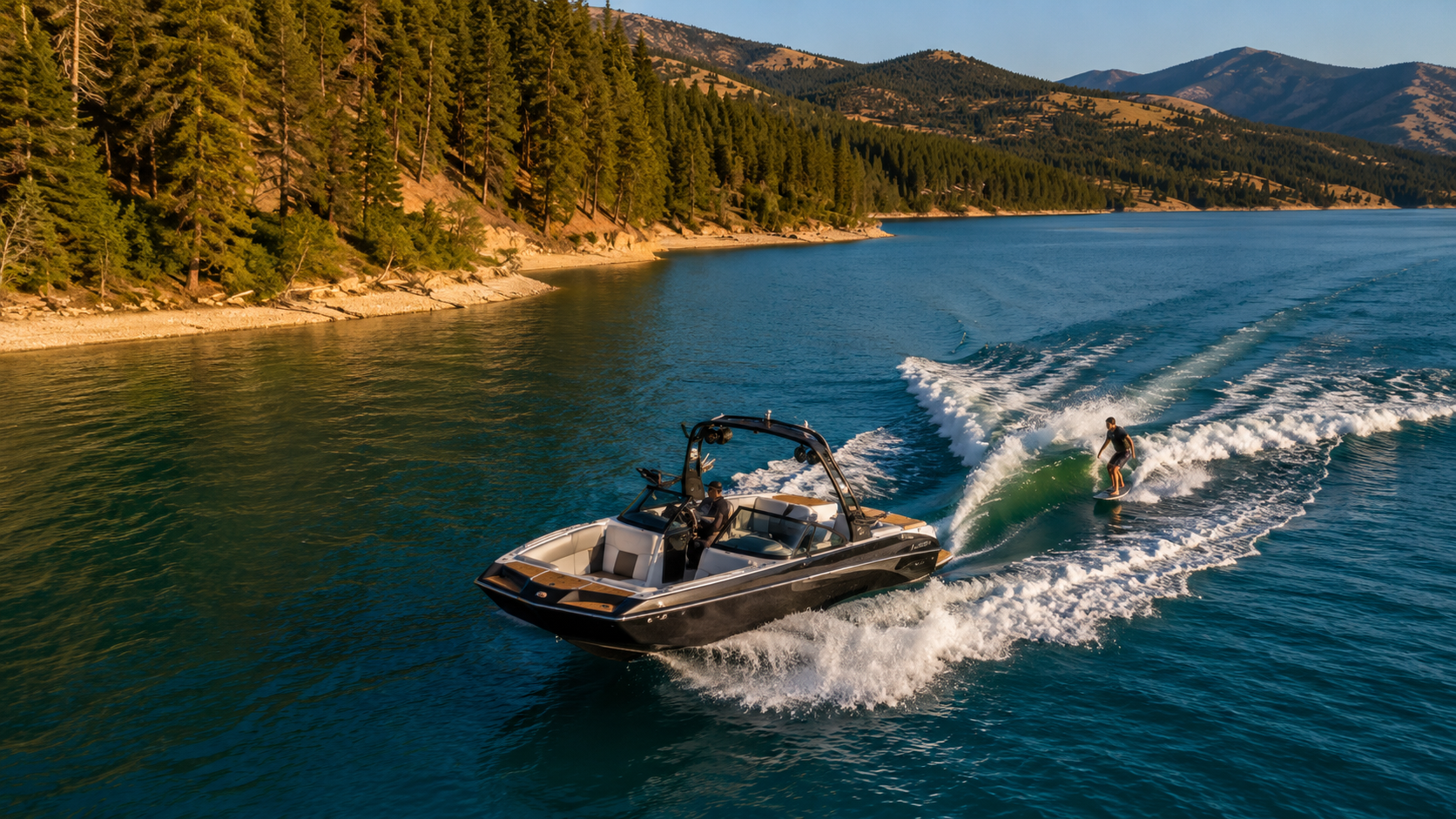
Lake Koocanusa BC wakeboating on turquoise water with pine forest and mountains in the background

The Water Level Is Not Constant — and That Changes Everything

Lake Koocanusa is a reservoir, not a natural lake. Water levels are controlled by the Libby Dam in Montana, managed by the US Army Corps of Engineers for downstream flood control, hydroelectric power, and irrigation. The lake fills through spring and early summer and draws down from late summer through fall and winter.

This is what surprises buyers most. A property that looks perfectly situated on the water in July might have 20 to 30 feet of exposed shoreline by October.

The practical implication for dock and boat access is real. Floating docks work well here precisely because of the variable water level. Fixed docks can become unusable at low water. Before making an offer on any Lake Koocanusa property, you need to understand the specific water access situation and how it changes across the season, not just how it looks in the listing photos, which are almost always taken in peak summer.

The Canada / USA Border Runs Through the Middle of the Lake

Roughly 42 kilometres of Lake Koocanusa sits in British Columbia. The southern portion crosses into Montana. This matters more than most people expect.

American buyers sometimes assume they can look at property on both sides of the border in the same search process. They can't. BC real estate and Montana real estate are completely separate transactions with completely different legal, tax, and financing frameworks. If you're a US buyer looking at the BC portion of Lake Koocanusa, you're buying Canadian property and all the rules that come with that apply.

On the Canadian side, the BC Property Transfer Tax applies to all purchases, and non-residents need to understand any additional obligations that apply to them specifically. This is something I walk every American client through in detail before we start, so there are no surprises partway through a transaction.

Not All Waterfront Properties Are What They Appear to Be

This is true in most markets, but it’s especially relevant on Koocanusa. Some properties described as waterfront have direct, deeded lake access with a dock. Others are across a road from the water with a shared right-of-way. Others sit at elevation above the lake with beautiful views but require a walk / drive down to the water.

The way a property is described in a listing is not always a complete guide to what the access actually looks like on the ground. Part of my job here is to help you understand exactly what you’re buying - the title, the access rights, the water lease if there is one, and how the property functions at different water levels throughout the year.

So don’t buy a Koocanusa property based on photos alone. The seasonal variation in how these properties look and function is significant enough that site visits at different times of the year are worth doing.

STR Rules fall under the RDEK

If you’re buying on Lake Koocanusa with a plan for short-term rental, you should know that much of the lake falls within Regional District of East Kootenay jurisdiction, and the rules around short-term rentals in rural areas have evolved recently at the provincial level.

There is demand for Koocanusa vacation rentals - the lake draws visitors from across BC, Alberta, and the Pacific Northwest, and summer occupancy rates are excellent on well-marketed properties. But you need to understand the current rules for the specific property and area before you build an investment thesis around rental income.

I always verify the current STR regulations for any specific property before a client makes a financial decision based on rental projections. Getting that clarity before making an offer is a lot easier than getting it after.

Why This Lake Is Genuinely Special

After all of that, I want to say something clearly: Lake Koocanusa is exceptional. The colour of the water is a deep turquoise blue that intensifies in direct summer sun. The surrounding mountains are snow-capped and dramatic. The summers are reliably warm and long by Kootenay standards. The community of people who have properties here is loyal and tight-knit. Properties on this lake hold their value because there are a finite number of them and the demand is genuine.

If you’re interested in the lake country, I’d love to show you around properly. There are properties and pockets of the lake that are less well known, but are really worth a visit in person. That’s where 8 years of working this market and getting to know this area really matters.

Lake Koocanusa is one of BC’s most remarkable waterfront destinations, and one where local knowledge makes the difference between a great purchase and an expensive surprise. Call or text me at (778) 745-0347, or send a note to phil@philgadd.com. I know this lake well, I'm invested in the area personally because I love it so much, and I’m happy to walk you through what would suit your needs.

Phil Gadd is the owner of First Tracks Real Estate Group, operating under eXp Realty in Fernie, BC. With deep local knowledge and a client-first approach, Phil helps buyers and sellers across Fernie, Sparwood, Jaffray, and Lake Koocanusa find their perfect mountain property. 72 five-star Google reviews. livinginfernie.com | 778-745-0347

Posted in Real Estate News
June 10, 2026

What Does $1 Million Buy You in Fernie BC Right Now?

I hear this fairly often - someone quotes a number they've seen on a listing, or a friend tells them what a place sold for, and they come away with the impression that a million dollars in Fernie doesn't stretch very far. The market has moved, prices are up, and the story they've pieced together is that the window has closed.

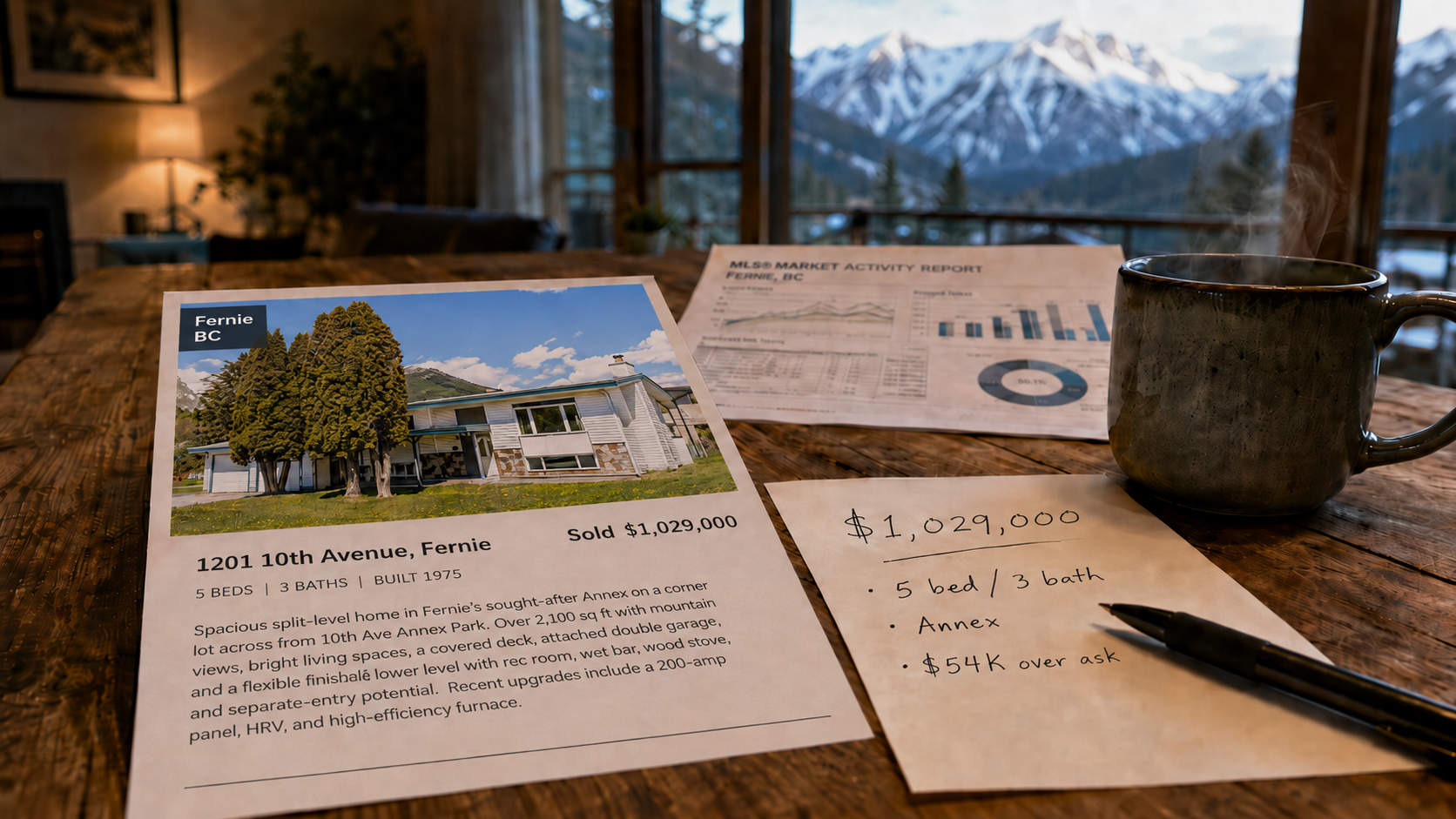
A warm mountain home interior. Weathered wooden table holding a property listing sheet, a handwritten note reading "$1,000,000", and a steaming coffee mug. Through the window behind, a snow-dusted Fernie mountain ridge.

Here's the more honest picture: a million dollars in Fernie in 2026 still buys you something meaningful. It just doesn't buy what it bought three years ago. Whether that's a problem depends entirely on what you're comparing it to - and most of the people I talk to are comparing it to the wrong thing.

Let me show you what $1 million actually gets you right now, across three different scenarios.

Scenario One: A Move-In Ready Detached Home

At $1 million, you're in solid detached home territory in Fernie. Not the very top of the market, but genuinely in the running for a well-maintained, move-in-ready single-family home in an established neighbourhood.

What that looks like in practice: three or four bedrooms, a double garage or carport, a proper yard, updated mechanicals, and a location within the town boundary - think Ridgemont, the Annex, or a smaller new build. If the property has been renovated or is newer construction, you may be looking at quartz countertops, a heat pump, EV charger rough-in, and finishes that reflect a buyer pool that demands decent interior finishing and quality materials.

However, if you want a detached home in The Cedars or Montane - Fernie's more sought-after residential neighbourhoods - a million dollars will get you to the starting line, not the finish. Homes in those neighbourhoods with mountain views and premium finishes often start at $1.2M to $1.5M, depending on the year they were built and the finishing quality.

But a move-in-ready family home, properly located, with a real backyard and a garage? That's still a million-dollar purchase in Fernie, and it's a good one.

Scenario Two: A Premium Townhome or Half-Duplex

If you're buying as a part-time user, an investor, or someone who wants lower maintenance without sacrificing quality, a million dollars opens up the best of Fernie's townhome and half-duplex market.

The top end of Fernie's multi-family market has moved upwards over the past two years. Well-positioned townhomes - newer construction, good strata management, proximity to the resort access road - are now regularly transacting in the $850K to $1.1M range. At a million dollars, you have decent choice in this segment.

What you're getting: two to three bedrooms, quality finishes, low-maintenance living, and in some cases direct access to ski terrain or trail networks. The best units have decks with mountain views, attached garages, and strata fees that reflect a well-run building rather than one that's been deferring maintenance.

For buyers interested in short-term rental income, this is also the segment where the STR math starts to make serious sense - provided you've verified the strata permits it. A well-positioned Fernie townhome running as a strong STR can generate $40,000 to $50,000 in gross annual revenue. That doesn't cover a million-dollar mortgage on its own, but it changes the carrying cost conversation significantly.

Scenario Three: Something Special — Land, Views, or Mountain Access

Take a million-dollar budget and go looking for something a little different, and Fernie can still surprise you.

In town, a million dollars with the right timing can find you an older home on a large lot in a prime location - something you may need to renovate substantially, building equity through the work. West Fernie in particular has a cluster of larger residential properties that attract buyers with this kind of project appetite.

Further out, the Elk River corridor toward Morrissey or the properties above Fernie toward the valley walls start delivering acreage, privacy, and views. A million dollars in that direction buys a genuinely different lifestyle.

What $1M Doesn't Buy You Anymore

Let's be direct about this, because the market has moved and pretending otherwise helps no one.

A million dollars no longer buys you a brand-new luxury detached home in a premium Fernie neighbourhood with ski-in access and high-end finishes. That product exists, but it's a $1.5M to $2.5M conversation depending on the specifics.

It doesn't buy you much if you want to purchase a lot and build a new home. The lots themselves are $250-350K, and construction costs in this market have climbed to the $500/sq ft range in this area.

And if you've been watching Fernie listings for a few years and remember what a million dollars looked like in 2021 or 2022, you're going to notice the shift. The market ran hard during and after the pandemic years, and while it's not moving at that pace now, it certainly hasn't reversed.

The Right Comparison

Here's the thing about the 'you can't get much for a million anymore' narrative: it's usually coming from someone who's comparing Fernie to itself five years ago, not to anywhere else.

Compare a million-dollar Fernie property to what a million dollars buys in Canmore right now (a smaller townhome, fewer options, tighter STR rules) and Fernie still looks good. Compare it to what a comparable mountain lifestyle costs in Whistler, Revelstoke, or any US ski market, and it looks very good.

Fernie's market has grown up. A million dollars here isn't what it was. But in the context of what mountain real estate actually costs in 2026, it's still a number that opens real doors - if you know what you're looking for and have someone who can show you where the value actually sits.


If that's you, I'd genuinely enjoy the conversation. Reach out to Phil at 778-745-0347 or phil@philgadd.com.


Phil Gadd is the owner of First Tracks Real Estate Group, operating under eXp Realty in Fernie, BC. With deep local knowledge and a client-first approach, Phil helps buyers and sellers across Fernie, Sparwood, Jaffray, and Lake Koocanusa find their perfect property. 72 five-star Google reviews. livinginfernie.com | 778-745-0347
June 3, 2026

Moving to Fernie BC: The Honest Guide

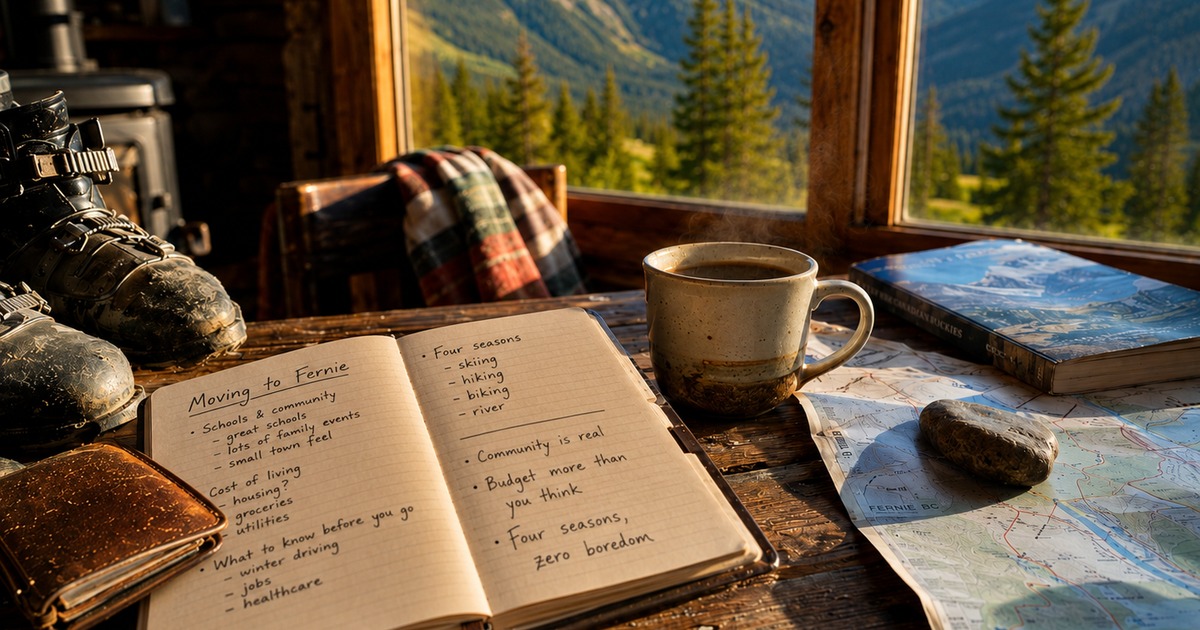
living in Fernie BC real estate guide

I've been selling real estate in Fernie for 8 years and living here for 17 years, so I know this town pretty well - the parts that make people fall in love with it and the parts that catch newcomers off guard. This post is the guide I wish someone had handed me, before I made the move.

Most real estate content about Fernie sells the dream. The mountain, the powder days, the sense of community. All of that is real and none of it is exaggerated. But there's more to the picture, and buyers who come in with a complete and honest understanding of life in Fernie tend to be the happiest ones after they've settled in.

What's Great (and Why People Never Leave)

Let's start with what's true: Fernie is a genuinely special place to live. The ski mountain is 10 minutes from downtown and consistently delivers some of the best snow in North America. Fernie Alpine Resort gets over 900 cm of annual snowfall in a good season, and the terrain is diverse enough that families with young kids and expert skiers with decades of experience can all enjoy the mountain.

But skiing is just one season. Summers in Fernie are excellent. The Elk River running through town is one of the best fly-fishing spots in western Canada and draws paddlers, swimmers, and picnickers from May through October. The extensive trail network - including Ridgemont, Montane, Provincial Park, Island Lake and Mount Fernie - draws riders and hikers from across the continent. Biking, hiking, climbing, camping; the outdoor recreation opportunities never stop.

The community is the other thing that catches people off guard in the best way. Fernie is small enough that you genuinely know your neighbours, your kids' teachers, the people you buy groceries from. The Memorial Arena is a hub in hockey season. 2nd Avenue has local restaurants and stores that have been here for years. There is a rootedness to Fernie that larger mountain communities have often lost as they've grown. You feel it pretty quickly when you arrive.

The Winters: What You're Actually Signing Up For

Fernie winters are full on. The snowfall that makes the mountain world-class, is the same snow you're shovelling on your driveway, off your roof, and dealing with on the roads. If you're moving from a mild-climate city and have never experienced a genuine Rocky Mountain winter, give this some honest thought.

The town handles snow well. Local plowing is reliable on main streets, and Fernie residents develop a rhythm around winter that becomes second nature within a season or two. But you will need a good set of winter tires, a reliable vehicle, and good gear. Some winters are long. March and April can still deliver significant snowfall.

The Crowsnest Pass occasionally closes or sees difficult conditions in severe weather, which matters if you're planning to drive to Calgary, Lethbridge, or need to travel regularly in winter. Most residents have a story of getting trapped in the Pass overnight in a snowstorm.

None of this is a deterrent for people who love winter and move here specifically for it. But for people who tolerate winter but don't love it, it's worth an honest conversation before you commit to a purchase.

Cost of Living: What Most Guides Don't Tell You

Real estate in Fernie costs money - we've covered that elsewhere. But the cost of groceries, services, and day-to-day living is also higher than other areas.

Fernie is not a large urban centre with competitive pricing across all consumer categories. Groceries at our local stores generally cost more than at a Costco or a Superstore. Certain services - trades, contractors, specialty retail - reflect the smaller labour and supply pool of a mountain town.

The upside is that some things cost less or go further: you're not paying for parking, traffic is measured in minutes rather than hours, and there's a reasonable cost of recreation once you've made the initial investments (gear, passes, etc.). But if you're budgeting a move to Fernie, don't plan your grocery spend based on what you pay in Calgary.

Internet, Healthcare, and Services: The Practical Reality

Most of the town now has access to fibre connectivity and high speed internet. For remote workers, this has changed the equation considerably compared to even five years ago - working from Fernie is genuinely viable for many people in a way it wasn't before.

Healthcare is a real consideration. Fernie has the Elk Valley Hospital with emergency services and some specialist access. But for complex procedures, specialist appointments, and certain healthcare needs, you will be travelling to Cranbrook (about an hour), Calgary (3 hours), or even to Kelowna / Vancouver. People who have significant ongoing medical needs should understand this part of the picture clearly before making a long-term commitment.

Schooling is good. Fernie has a solid elementary and secondary school system, and there is a strong community around youth sports, arts, and outdoor education. Many families who move here specifically cite the quality of life for kids as one of the best parts of Fernie. Kids grow up outside, connected to the mountain and the outdoors, in a community where they're known.

Air travel requires either driving to Cranbrook Airport for limited regional service or making the trip to Calgary International for full connectivity. For people who travel frequently for work or family, this is one of the real trade-offs.

What Surprises People Most

Almost everyone who moves to Fernie says the same thing after their first year: they didn't expect the community to feel so real so quickly. This is not a resort bubble. People have deep roots here. Families go back generations. And yet newcomers are genuinely welcomed - especially those who show up willing to participate, to join the hockey association or the mountain bike club, to volunteer for the events that make the town tick.

The pace of life surprises people too. It's slower than a city, in every dimension. The lineups are short. The commutes are nothing. The evenings are quiet. The stars shine brightly. For some people this is an adjustment; for most of the buyers I've worked with who made the move, it becomes one of the things they're most grateful for.

The mountain access never gets old. That's the other consistent thing I hear. Years in, people still say they look up at the mountain on a powder day and feel something. That part does not go away.

Who Fernie Is For — and Who It Might Not Be Right For

Fernie is a great fit for people who genuinely love an outdoor lifestyle across multiple seasons, who value community connection over urban convenience, and who are either self-sufficient in their career (remote workers, self-employed, established in a local field) or have transferable skills in trades, healthcare, tourism, or education.

It is probably not the right permanent move for someone who needs easy access to major healthcare on an ongoing basis, who relies on a large and varied urban job market, or who is primarily driven by urban amenities like diverse dining, retail, cultural events, and nightlife.

Most buyers know which camp they're in. The move to Fernie tends to be a value-driven decision more than a purely financial one. People come here because they want a different kind of life, and by and large, they find it.

I've helped a lot of people make this move over the years. The ones who thrive are almost always the ones who came in with clear eyes, honest expectations, and a genuine love for what Fernie offers. The buyers who struggle are usually the ones who fell in love with the dream of Fernie without quite accounting for the reality of it.

Both the dream and the reality are good. Fernie delivers on what it promises - you just have to know what you're actually signing up for.


If you're seriously considering a move to Fernie and want to talk through the real picture — lifestyle, neighbourhoods, what your budget gets you, and what the process looks like — reach out to Phil at 778-745-0347 or phil@philgadd.com.


Phil Gadd is the owner of First Tracks Real Estate Group, operating under eXp Realty in Fernie, BC. With deep local knowledge and a client-first approach, Phil helps buyers and sellers across Fernie, Sparwood, Jaffray, and Lake Koocanusa find their perfect property. 72 five-star Google reviews. livinginfernie.com | 778-745-0347
May 26, 2026

What Does $700,000 Buy You in Fernie BC Right Now?

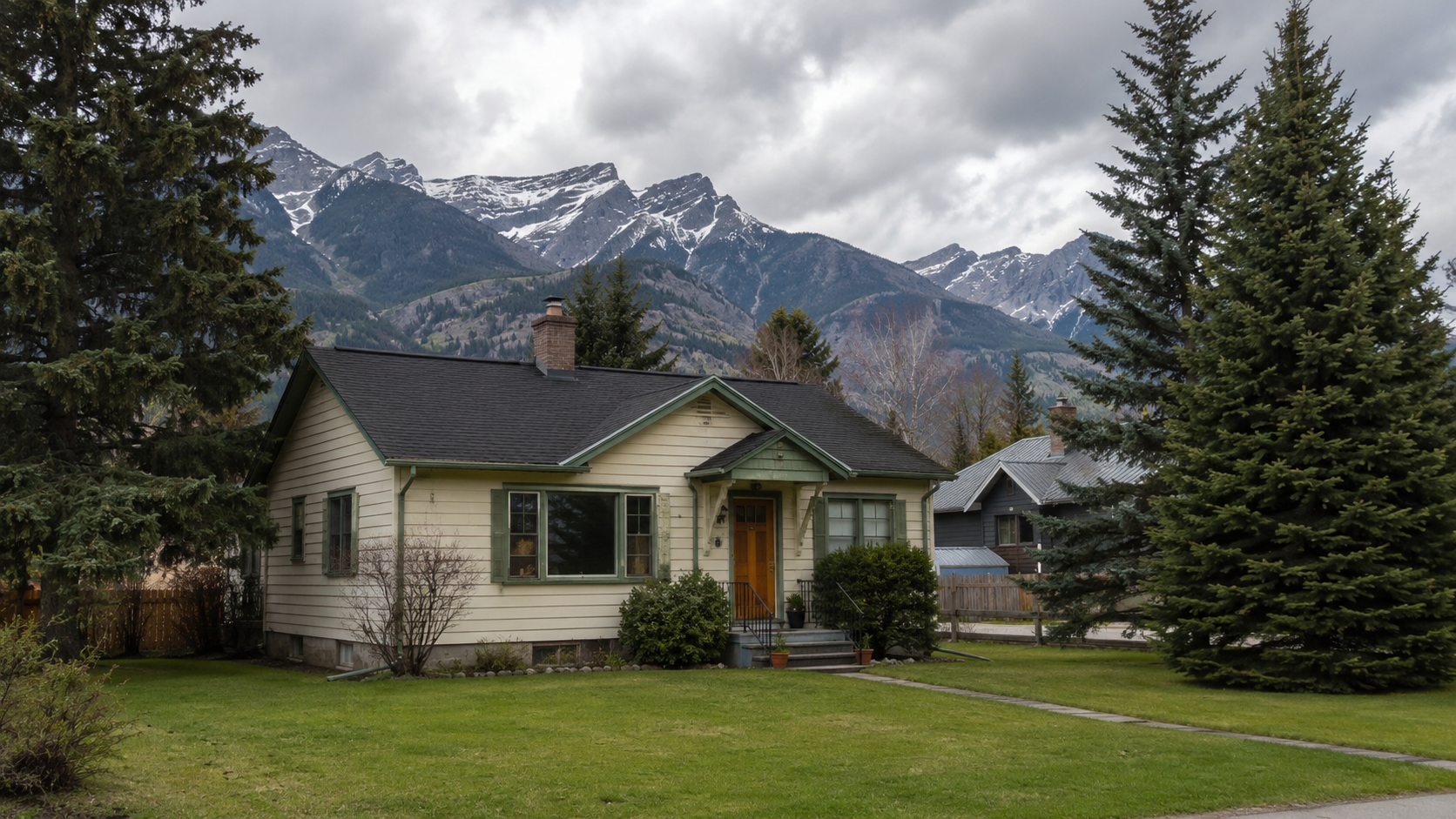
Fernie BC townhome with mountain views in a quiet residential neighbourhood

Price-anchored research is one of the most common ways buyers start their Fernie journey. They have a number in mind, they want to know what it buys them, and they want to see real examples before they call anyone. This post is for that buyer.

$700,000 is a meaningful budget in Fernie. It gets you into the market in a real way — not at the lowest entry level and not at the high end, but right in the range where you have genuine options across different property types. Here is what that number is working with right now, across three different categories.

Option 1: A Townhome Near the Core

At $700K, you're in solid townhome territory in Fernie. Think two to three bedrooms, a garage or covered parking, a small outdoor space, and a location within a reasonable distance of downtown and the highway. Newer townhome buildings in this price range have typically been updated with modern finishes — open kitchens, decent primary bedrooms, and nice views from a deck or balcony.

The trade-off at this price point is usually square footage and outdoor space. Townhomes in the $650K-$750K range are efficient rather than expansive, which suits buyers who want low-maintenance mountain living or a property they'll use seasonally and leave locked up without worry.

These types of homes will usually be in a strata, so you'll need to read the strata documents carefully before an offer — not after. Check the rules around pets, short term rentals, what the fees are and what services they include.

Who this suits: couples, small families, seasonal users, buyers downsizing from larger properties, and investors who are willing to do the strata due diligence.

Option 2: An Older Detached Home with Character

At $700K, you can find a detached single-family home in Fernie — but you're likely looking at older stock, which in Fernie typically means character-filled homes in established neighbourhoods like West Fernie, the downtown core, or the Annex.

West Fernie specifically offers some of the most affordable detached home options in the area, with the Elk River as your backyard and a short bike or drive to town. Properties here tend to sit on larger lots and offer the kind of outdoor space — big yards, gardens, room for a dog and a woodpile — that townhome living doesn't.

The honest picture at this price point for detached homes: you may be inheriting older systems (furnace, roof, windows) and you should budget for renovations and maintenance work. The properties that have been renovated and modernized in this range will move faster and occasionally over asking. The ones that need love are where the value sits.

Who this suits: buyers who want land, a yard, and space — families, buyers who want a permanent primary residence rather than a lock-and-leave, and people who can take on a project and build equity through upgrades.

Option 3: A Cabin or Small Acreage Outside Town

Take that $700K budget outside the Fernie town boundary and the options shift. In the surrounding area — toward Jaffray, the Hosmer area, or properties along the Elk River corridor — a $700K budget can access a small cabin on acreage or a rural residential property with significantly more land and privacy than you'd find in town.

This category appeals to a specific buyer: someone who values space and quiet over walkability and proximity to amenities. If you're thinking about a property you'll use for homesteading and outdoor living, with schools and stores a secondary draw rather than the primary one, this type of property deserves a look.

The trade-offs are real: you're further from town services, you'll be doing more driving, and rural properties carry different maintenance considerations. But for the right buyer the value compared to what $700K buys in town is striking.

Properties around Lake Koocanusa, Tie and Rosen Lakes, also open up at this budget. Lakefront and near-lakefront options are available in this range that simply don't exist anywhere close to what a buyer would pay on comparable BC lakes closer to Vancouver.

What the $700K Market Is Doing Right Now

The $700K range is active. Properties in this bracket that are well-presented, in good condition, and correctly priced are not sitting for long. The broader Fernie market is selling at about 98% of asking price on average, and that pattern holds in this range.

If you're a buyer at $700K, having your financing arranged and being ready to move when the right property comes up is genuinely important. The days of deliberating for two weeks and scheduling a second viewing at your leisure are behind us in this market.

A $700K budget in Fernie gives you real options. Which option is right depends on what you're actually looking for — a vacation base, a family home, an investment property, or a rural retreat. Getting clear on that before you start booking viewings saves a lot of time.

This post is part of an ongoing series looking at different price points in the Fernie market. If you'd like to see what $500K, $900K, or $1.2M gets you, those are coming.

If you're working with a $700K budget and want to see what's currently active, call or text Phil at 778-745-0347 or email phil@philgadd.com — happy to pull the current inventory and walk you through the options.


Phil Gadd is the owner of First Tracks Real Estate Group, operating under eXp Realty in Fernie, BC. With deep local knowledge and a client-first approach, Phil helps buyers and sellers across Fernie, Sparwood, Jaffray, and Lake Koocanusa find their perfect property. 72 five-star Google reviews. livinginfernie.com | 778-745-0347
May 20, 2026

Can You Actually Make Money on an Airbnb in Fernie? The Honest Numbers

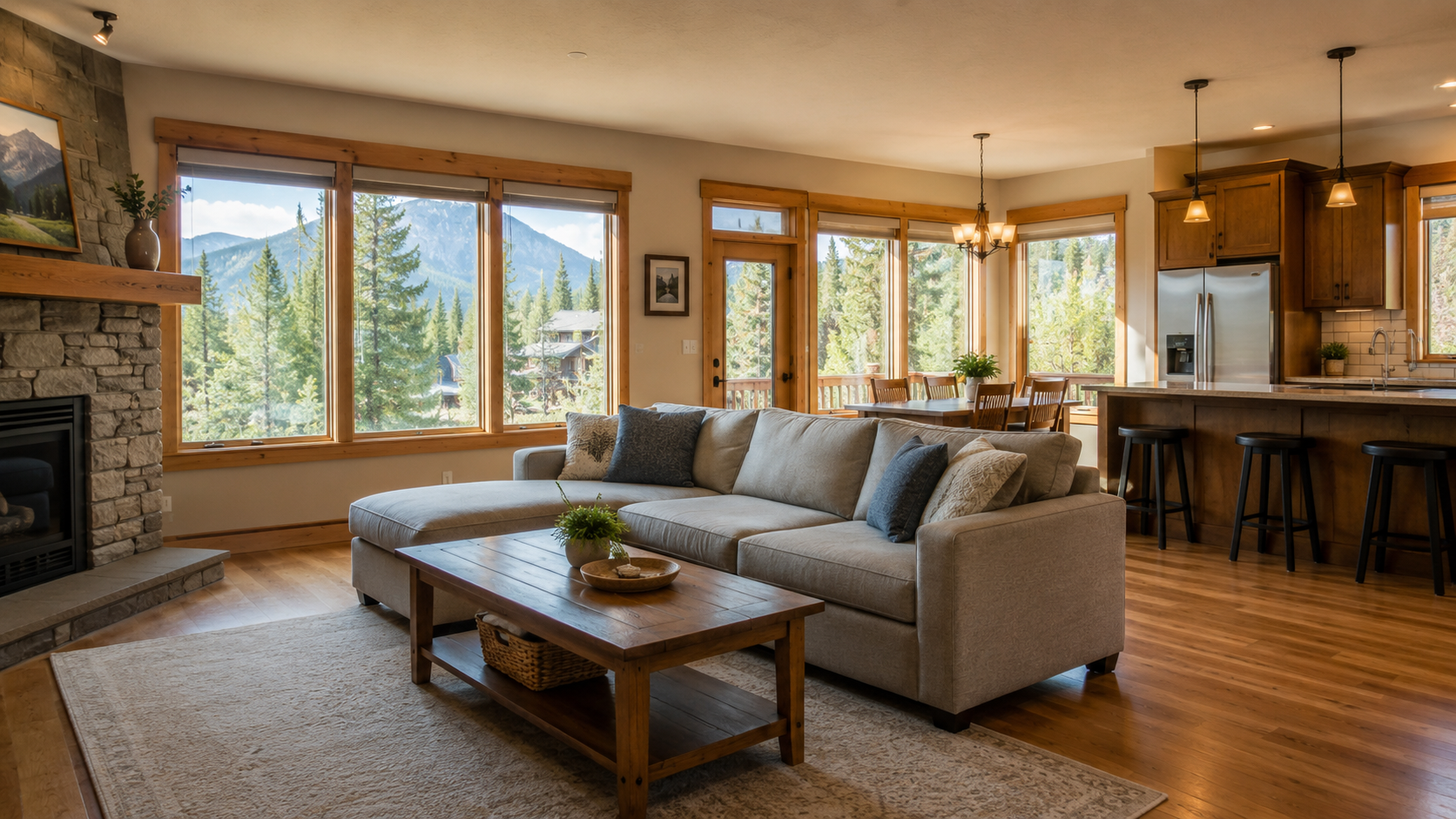
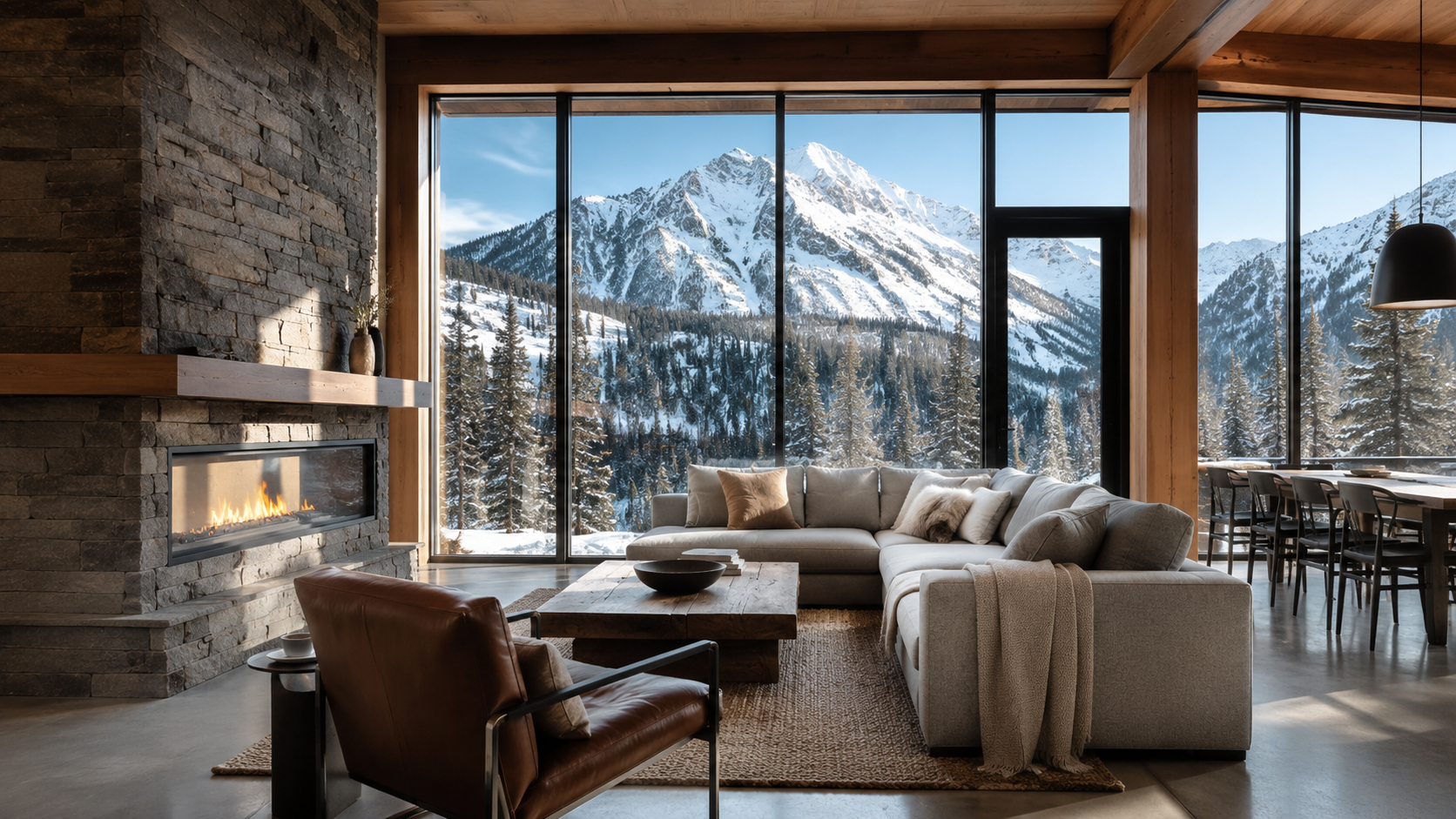
Short term rental Fernie real estate — mountain modern chalet interior with ski hill views

Some buyers come to Fernie with an investment thesis already formed. They've looked at the ski town, seen the tourism traffic, and assumed a Short Term Rental (STR) here is a reliable income machine. Some of them are right. Some of them haven't asked the right questions yet.

This post is for the buyer who wants the real picture before they start writing offers. What does an STR in Fernie actually earn? What does zoning allow? And what are the things buyers underestimate when they're doing their math?

What the Numbers Actually Look Like

Based on current STR data for Fernie, the average Airbnb listing earns around $190 CAD per night. The median nightly rate sits closer to $150, as the average is pulled up by top-performing properties. Properties in the top 25% of performers earn $230 or more per night; the top 10% command $320 or more.

Average occupancy across the Fernie STR market runs at about 43%. That number also varies significantly: lower-performing properties average around 26% occupancy, while well-run, well-positioned listings are substantially higher.

So lets run the math on a mid-tier property: $150 average nightly rate at 43% occupancy over a year works out to roughly $23,000 CAD in gross annual revenue. A strong performer at $230/night and 60% occupancy gets you closer to $49,000 CAD gross.

These are starting points; your net income depends on management fees, cleaning costs, platform fees, maintenance, mortgage, and property taxes.

What Zoning Actually Allows in Fernie

This is where a lot of would-be investors go wrong. They find a property they love, run the STR numbers in their head, and then discover that the property isn't eligible for a short-term rental licence.

In Fernie, STRs are permitted in primary residences in residential zones. Condo and hotel properties in commercial zones including C-1, C-HWY, CD-2, and R3R are also eligible. Secondary suites, detached suites, garden suites, and secondary homes in residential zones generally do not qualify.

Every STR operator in Fernie needs a City of Fernie business licence. Provincial registration through BC's STR registry is also required. The province's principal residence requirement applies broadly in BC, but Fernie — as one of 14 designated Resort Municipalities — has certain flexibilities that other BC communities do not have.

What this means in practice: if you're buying an investment condo in a condo-hotel zone specifically to run as an Airbnb while you're not there, that's generally viable in Fernie. If you're buying a residential detached home as a non-primary residence and planning to rent it out short-term while you use it a few weeks a year, the rules get more complicated.

Always verify the specific zoning and strata rules for any property before you make an offer with STR income as part of your plan. Do not rely on what a neighbour tells you or what a listing agent implies.

The Seasonality Reality

Fernie is a four-season destination but it is not a four-season equal destination. Ski season (December through March, sometimes into April) is the clear peak. Nightly rates are highest in January. Occupancy peaks in winter months for properties near the resort.

Summer has grown significantly as a Fernie draw — mountain biking, hiking, the Elk River, and the general mountain escape factor have made July and August genuinely busy. But there are shoulder seasons in spring and fall where occupancy softens for many STR operators.

Operators who do best in Fernie are usually the ones who have thought carefully about shoulder-season positioning: pricing adjustments, minimum stay tweaks, targeting specific summer visitor segments, and making their properties stand out with well-staged photos and professional listings. The investors who struggle are usually the ones who projected peak-season occupancy across the full year without accounting for April-May, October-November.

What Buyers Get Wrong

A few things I see over and over when buyers are evaluating STR properties in Fernie.

First, they assume the gross revenue is the net. Management fees typically run 20–30% of gross revenue if you're using a local property manager. Add platform fees, cleaning between stays, supplies, maintenance, and the occasional repair, and your net income from a $40,000 gross-revenue property might be $22,000–$26,000.

Second, they underestimate the competition. There are over 250 active STR listings in the Fernie market. Not all of them compete directly with each other, but a new, average-quality listing does not automatically perform at average occupancy. Positioning, photos, pricing strategy, and responsiveness matter.

Third, they don't read the strata documents. Some strata corporations in Fernie prohibit short-term rentals regardless of zoning. A property can be in an eligible zone and still be STR-restricted by its own bylaws. Read the strata documents. Read them carefully.

When the Numbers Do Work

None of this is meant to be discouraging. The numbers absolutely can work in Fernie — for the right property, in the right zone, with realistic expectations and a professional approach to the listing.

The strongest STR operators in this market tend to own condo-hotel zoned properties close to the resort or in the downtown core, manage their listings actively or use experienced local managers, price dynamically across seasons, and treat the rental as a business with proper accounting and compliance.

For buyers who are buying something they'd love to use personally and want to offset holding costs with rental income, Fernie is also a reasonable place to do that — provided the property is STR-eligible and the personal use weeks don't hollow out your peak-season revenue.

The STR income story in Fernie is real. It just requires homework, not assumptions.

If you're evaluating a specific property for STR potential, I'm happy to walk through the zoning, the comparable revenue data, and the realistic net picture with you before you commit. Getting that clarity before an offer is always better than getting it after. Reach out to me at 778-745-0347 or phil@philgadd.com. STR investor inquiries are welcome — straight answers, no pressure.

Phil Gadd is the owner of First Tracks Real Estate Group, operating under eXp Realty in Fernie, BC. With deep local knowledge and a client-first approach, Phil helps buyers and sellers across Fernie, Sparwood, Jaffray, and Lake Koocanusa find their perfect property. 72 five-star Google reviews. livinginfernie.com | 778-745-0347
Posted in Real Estate News
May 13, 2026

Fernie vs Canmore: A Side-by-Side Comparison for Mountain Property Buyers

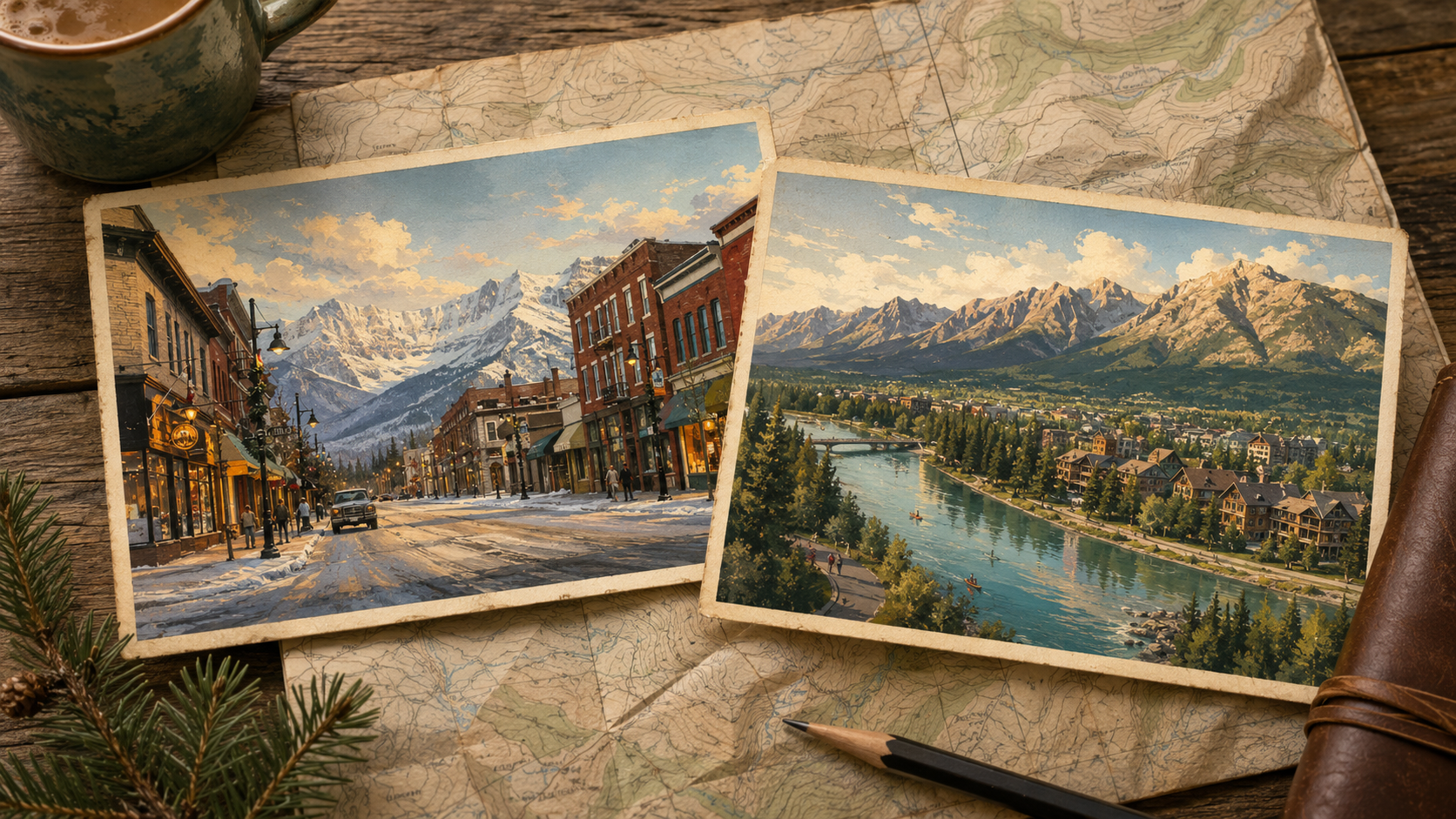
Fernie BC vs Canmore AB real estate comparison - vintage postcards on topographic map

If you've been researching mountain real estate in western Canada, there's a good chance both Fernie and Canmore have shown up on your radar. They're both legitimate contenders: ski hills, outdoor lifestyle, strong rental demand, and real communities of people who chose the mountains over the city.

But they're also quite different, in price, in feel, in the rules around short-term rentals, and in what kind of buyer they suit best. I chose Fernie, so I'm obviously not a neutral party! But I can give you an honest side-by-side so you can make the right call for your situation.

Price: The Most Obvious Difference

Canmore is more expensive. That's the short answer. As of spring 2026, the median home price in Canmore hovers around $1.2 million, with entry-level condos starting in the mid-$500Ks and luxury properties exceeding $3 million. Recreational properties in Canmore have averaged around $1.67 million according to recent reports.

Fernie's pricing is lower across the board. Most single-family detached home sales cluster between $840,000 and $1.2 million, with townhomes and half-duplexes ranging from $600,000 to $900,000 and entry-level condos starting around $400,000.

The gap is meaningful. A budget of $900,000 gets you a lot more in Fernie than it does in Canmore. That difference is one of the primary reasons buyers who discover Fernie after looking at Canmore often pivot quickly.

The Mountain Experience

Canmore is a basecamp. The skiing happens in Sunshine Village, Lake Louise, and Mount Norquay. They're excellent mountains, but you're planning a full day out and driving to access them. The proximity to Banff National Park is also Canmore's major attraction for summer — hiking in the Rockies, Banff townsite, Lake Louise. The scenery is world-class and easily accessible.

Fernie has its ski hill right at the edge of town. Fernie Alpine Resort is 10 minutes from downtown and consistently ranks among the top resorts in North America for snow quality and terrain. Over 900 cm of snow in a good year, 142 named runs, and a ski culture that runs deep in the community. You don't have to drive into a national park to ski. You just go.

For four-season lifestyle, both towns deliver. Fernie has the Elk River for fishing, kayaking, and rafting, mountain biking and hiking trails accessible from your backyard, and a downtown that doesn't thin out in the off-season. Canmore has the Bow River, the Rundle Forebay, and the Rockies as a literal backdrop for every outdoor activity imaginable.

Which mountain you prefer is honestly a personal thing. Spend time in both before you decide if you can.

Short-Term Rental Rules: A Critical Difference

This is one of the most important sections in this comparison for any buyer considering an investment property.

Canmore has very tight STR restrictions. The town has moved to limit short-term rentals in residential zones, largely to protect long-term housing availability. If you're buying in Canmore with the intention of running an Airbnb, your options are significantly constrained unless the property is specifically zoned or designated for tourist accommodation.

Fernie is a designated Resort Municipality under BC's provincial framework, which gives it more flexibility than most BC communities on STR rules. Short-term rentals are permitted in certain zones and property types, including some residential properties and condo-hotel-zoned buildings. The rules still require a City of Fernie business licence and compliance with provincial registration requirements, but the overall STR environment in Fernie is more investor-friendly than Canmore at the moment.

For buyers who want the option of generating rental income, this distinction matters a lot. Verify current zoning rules with your agent and the City of Fernie before any purchase.

Community Feel and Lifestyle

Canmore has grown significantly. With a population of roughly 15,000 and a steady flow of tourists year-round due to the proximity to Banff, it has a more developed commercial infrastructure and a slightly more cosmopolitan feel than Fernie. There are more restaurants, more retail options, and more people passing through at any given time.

Fernie is smaller, quieter, and tighter-knit. The population sits around 5,500 and the community is genuinely connected in a small mountain town way. You'll recognize faces at the grocery store. Kids attend school and play team sports together. People stop and talk on 2nd Avenue. It has a realness that's increasingly hard to find in other resort destinations.

Neither is better — it's a personality fit. Buyers who want more amenities, easier access to a major airport (Calgary is 90 minutes from Canmore), and the energy of a busier town often choose Canmore. Buyers who want genuine small-town community, more value for their money, and a ski hill out their back door often choose Fernie.

Access and Travel

Canmore wins on access. Calgary International Airport is about 75 minutes away, with frequent flights from across Canada and the US. If you're flying in regularly or have clients or family visiting, Canmore is logistically easier.

Fernie is a 3-hour drive from Calgary and Cranbrook Airport is about an hour up the road, with more limited flight service. For buyers who plan to drive down regularly from Alberta, or who want the option of a quick weekend trip, this needs consideration.

For buyers who are relocating permanently or who are driving or flying up from the US, the access story is different. Fernie is around 1 hour to the US border in Montana, and for that buyer profile, the logistics work well.

Resale Potential

Both markets have strong long-term fundamentals. Canmore's proximity to Banff National Park creates permanent scarcity and sustained demand. Fernie's natural boundaries (mountains on all sides) create their own version of supply constraint.

Fernie prices have moved meaningfully in recent years, up nearly 20% year-over-year in median price as of spring 2026. The market is still discovering its ceiling in a way Canmore already has. That's a double-edged observation: there's more upside potential, but also more uncertainty. Canmore is an established market with proven price floors. Fernie is still building its profile.

For most buyers, the resale calculus is secondary to the lifestyle question. If you love the property and the town, and you buy at a fair price in a market with genuine supply constraints, you're probably going to be fine in the long run.

Both Fernie and Canmore are excellent places to buy mountain real estate. The right answer depends on your budget, your lifestyle priorities, how often you plan to visit, and whether short-term rental income is part of your plan.

I obviously know (and love) Fernie best, and I'm happy to talk through what I know about both markets. If Canmore is the right call for you, I'll be honest about that - there's no bad choices here!


Reach out to Phil at 778-745-0347 or phil@philgadd.com for a no-pressure conversation about what makes sense for your situation.

ABOUT THE AUTHOR


Phil Gadd is the owner of First Tracks Real Estate Group, operating under eXp Realty in Fernie, BC. With deep local knowledge and a client-first approach, Phil helps buyers and sellers across Fernie, Sparwood, Jaffray, and Lake Koocanusa find their perfect mountain property. 72 five-star Google reviews.  livinginfernie.com

May 6, 2026

Fernie Real Estate Prices in 2026: What Different Budgets Actually Buy You

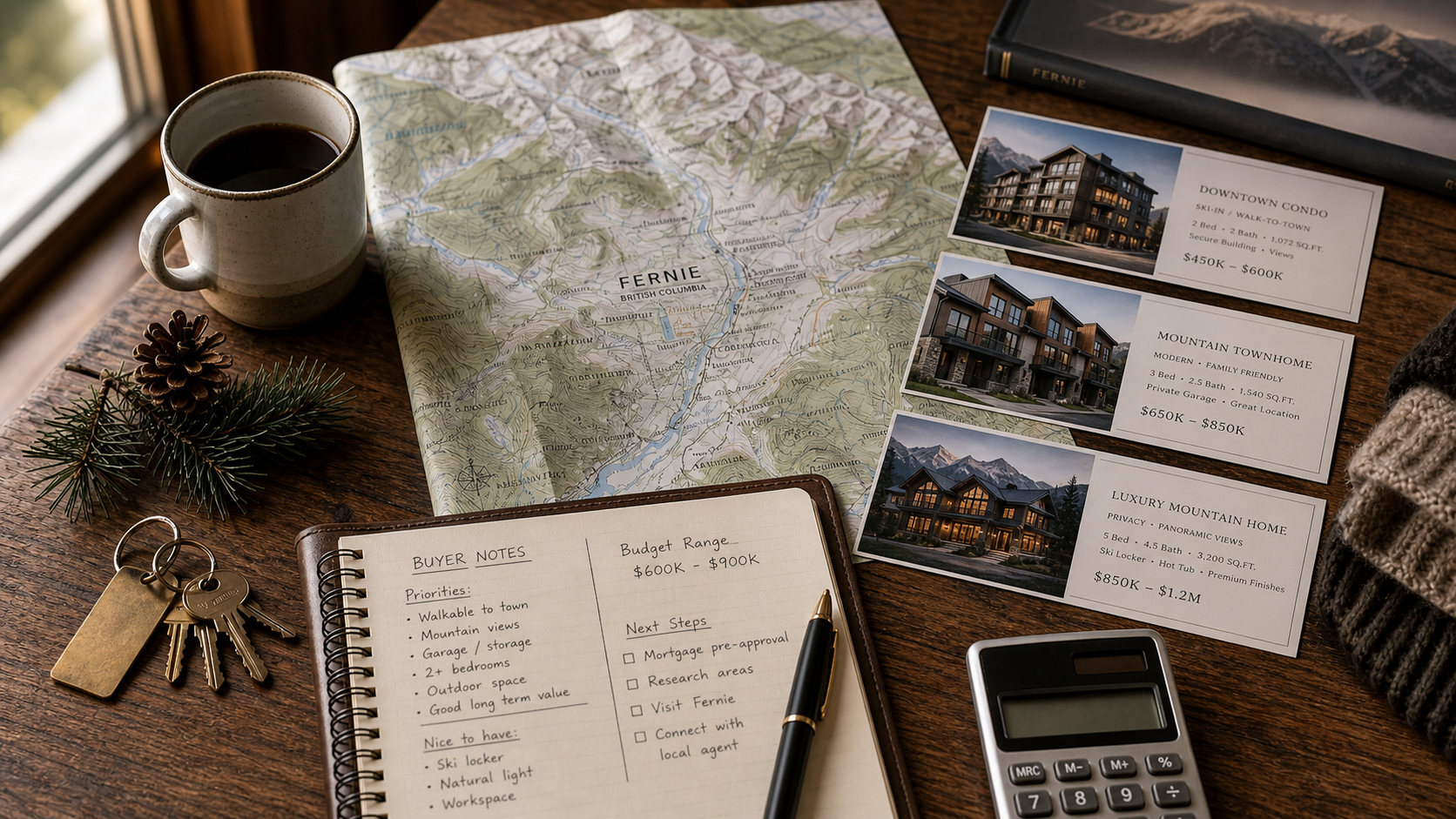
Fernie real estate buying plan with map, keys, notes, calculator, and property cards showing different home options.

The number one question I hear from buyers considering Fernie is some version of: 'Is it affordable for us?' It's a fair question. Fernie is a ski destination, and resort towns carry a premium. But the full picture is more nuanced than the headline numbers suggest.

Prices have climbed here over the past few years, no question. But compared to Canmore or Whistler, Fernie still offers real value for buyers. Let me break down what different budgets will get you in this market right now.

The Current Market Snapshot

As of spring 2026, the Fernie real estate market is active. New listings are up about 15% year-over-year, inventory sits at roughly 4.75 months, and homes are selling at close to 98% of asking price. The median price has climbed nearly 20% compared to spring 2025, which reflects genuine demand pressure across all property types.

The average listing price sits around $1.18 million, but that number is pulled up by high-end properties in areas like Alpine Trails, The Cedars, Montane, and Fernie Alpine Resort. For most buyers, the more relevant range runs from $400,000 on the low end to around $1.2 million for a move-in-ready detached home in a central neighbourhood.

Under $500K: Condos and Entry-Level Townhomes

At the sub-$500K mark, you're looking at the condo and smaller townhome segment. One-bedroom condos typically list around $400,000. You'll find some two-bedroom options in older complexes or further from the resort core in this range, but expect to do some work or make some compromises on finishes.

This is the entry point for buyers who want a foothold in Fernie without a big budget. For investors, this price point is also where the STR math starts to pencil out depending on the zone and strata rules. Not all condos in Fernie allow short-term rentals, so that's a due diligence step, not an assumption.

Who buys here: first-time local buyers, investors looking for an opportunity, or buyers from larger centres who want an affordable vacation base.

$500K to $800K: Townhomes, Half-Duplexes, and Older Detached Homes

This is where a lot of the action is right now. The $500K to $800K range gives you access to newer townhomes and condos with two to three bedrooms, duplexes in neighbourhoods like West Fernie, and older detached homes that may need updating but sit on decent lots.

Higher-end townhomes in this bracket, particularly those closer to the resort or with newer finishes, are moving quickly. If you're in this range and serious about a purchase, getting pre-approved and working with someone who knows the inventory in real time is important. Good properties at this price point do not sit.

Townhomes in this range typically run $700K to $900K depending on the building, location, and condition. Half-duplexes can offer more flexibility for buyers who want a yard or a bit more separation between neighbours.

$800K to $1.2M: Move-In Ready Detached Homes

This is the core single-family home range in Fernie. Most recent sales of detached homes have clustered between $840K and $1.2M. At this price point, you can expect a well-maintained three or four-bedroom home in a central neighbourhood with a yard, garage, and good access to amenities.

Buyers in this range include local families, people relocating from bigger centres, lifestyle buyers who want year-round mountain living, and some investor-operators looking for properties with suite potential or enough space to justify the purchase for personal use plus rental income.

Properties in Fernie that are well-maintained, move-in-ready and updated for energy efficiency (heat pumps, EV chargers) are drawing the most attention from buyers right now.

Over $1.2M: High-End and Resort-Adjacent Properties

Above $1.2M, you're looking at premium detached homes, larger acreage properties on the outskirts of town, ski-in-ski-out or resort-adjacent properties, and the highest-end builds in Fernie. The Cedars, Montane, and Fernie Alpine Resort properties commonly transact in the $1.5M to $3M+ range.

This segment attracts a different buyer: often someone who has already done well financially elsewhere and is choosing Fernie as a lifestyle investment or a primary residence upgrade. Cross-border buyers from the Pacific Northwest are increasingly active here, drawn by the currency advantage and Fernie's relative value compared to comparable resort markets in the US.

The Honest Answer on Affordability

Fernie is not cheap. If you're expecting ski-town lifestyle at suburban pricing, you'll be disappointed. But relative to most comparable mountain resort markets in Canada, Fernie still offers genuine value, especially when you factor in the lifestyle, the community, and the long-term trajectory of the market.

The buyers who do best here are the ones who come in with clear priorities: neighbourhood, property type, and a realistic sense of what their budget gets them. If you're thinking about making a move and want a straight-up look at what's available at your price point, that's exactly the kind of conversation I'm here for.

Fernie's market moves fast when the right property hits. Getting clear on your budget and what it realistically buys you before you start looking saves a lot of time and disappointment. If you want a no-pressure conversation about where you fit in this market, reach out.


Call or text Phil directly at 778-745-0347, or send an email to phil@philgadd.com. There's no obligation — just a straight answer about what's possible at your budget.

ABOUT THE AUTHOR

Phil Gadd is the owner of First Tracks Real Estate Group, operating under eXp Realty in Fernie, BC. With deep local knowledge and a client-first approach, Phil helps buyers and sellers across Fernie, Sparwood, Jaffray, and Lake Koocanusa find their perfect mountain property. 72 five-star Google reviews.  livinginfernie.com

April 29, 2026

Why Americans Are Buying Property in Fernie, BC Right Now

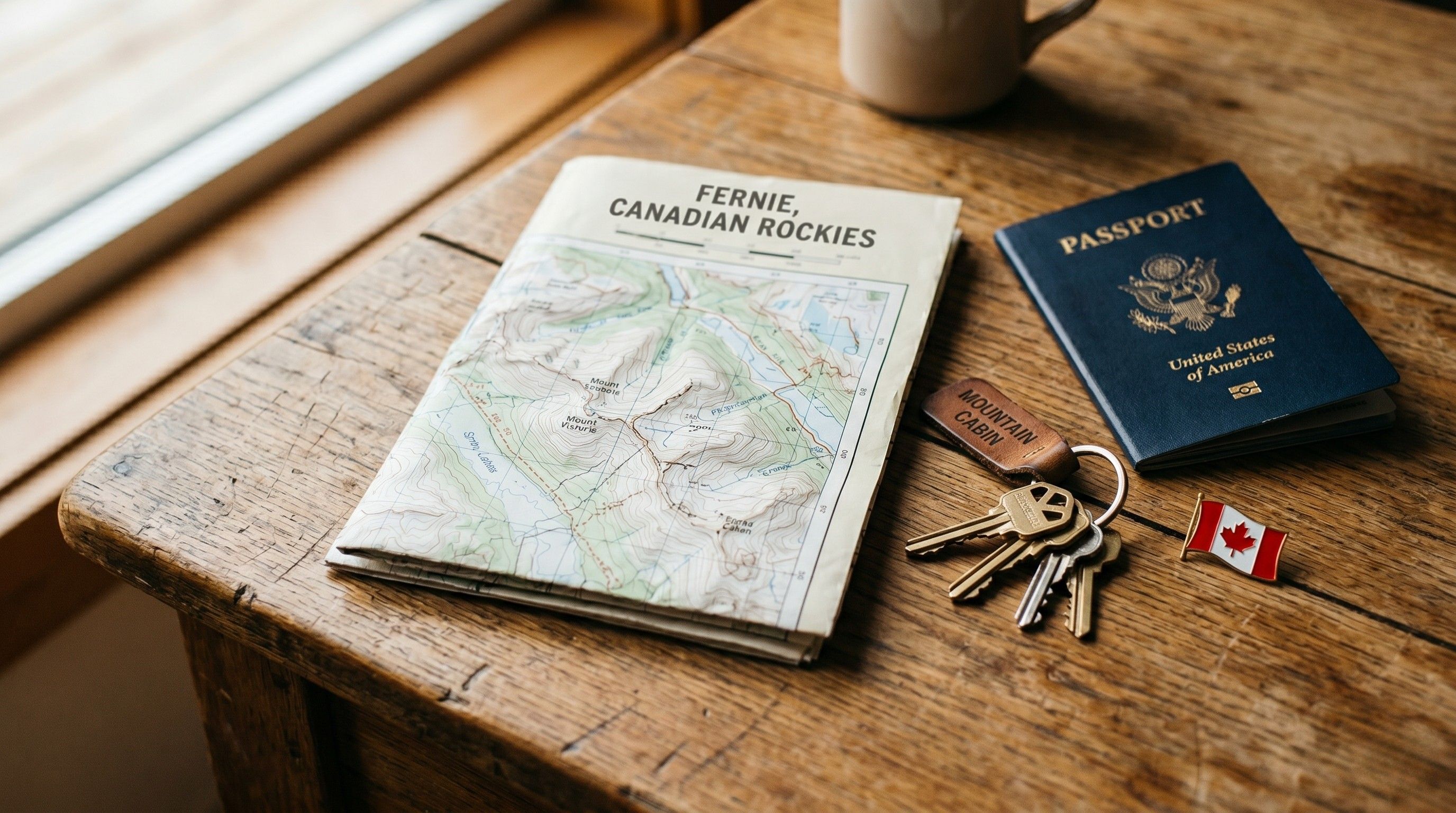
Americans buying property in Fernie BC - mountain town real estate

I’ve had more conversations with American buyers in the last 18 months than at any other point in my career. Some found Fernie through ski trips. Some came through friends who had already made the move. A few simply typed “mountain town real estate Canada” into Google one evening and ended up on the phone with me.

The reasons they’re looking are different for everyone. But there are a few things that keep coming up, and if you’re a US buyer exploring options, this one’s for you.

The Exchange Rate Still Works in Your Favour

Right now, one US dollar buys roughly 1.37 Canadian dollars. That’s not a once-in-a-generation anomaly, it’s where the rate has been sitting for a while, and it has a real effect on what your money can do here.

On a $750,000 CAD property (an average property price in Fernie), you’re spending approximately $550,000 USD. For buyers coming from US markets, those numbers represent a very different reality than what they’d find at home for the same quality of mountain lifestyle.

The exchange rate alone doesn’t make a deal. But it does make Fernie worth looking at seriously when you run the numbers.

Fernie Isn’t Affected by the Foreign Buyer Ban

Canada introduced a foreign buyer ban in 2023, which restricts non-Canadians from purchasing residential property in many parts of the country. A lot of American buyers hear about this and assume it applies everywhere.

It doesn’t apply to Fernie.

The ban targets areas classified by Statistics Canada as a Census Metropolitan Area or Census Agglomeration. Fernie isn’t one of them. Neither is most of the East Kootenay region. That means American buyers can purchase property here without the restrictions that apply in places like Vancouver, Victoria, or Kelowna.

This is one of the most important things to understand if you’re comparing markets across BC. Fernie sits in a different category.

What You Need to Know as a US Buyer

Non-Resident Speculation Tax: BC charges a 20% Non-Resident Speculation Tax (NRST) on property purchases by foreign nationals in certain regions of the province. Check with a BC real estate lawyer on whether and how this applies to your specific situation in the East Kootenay.

Down payment: Most Canadian lenders require non-residents to put down 35% or more. Some US buyers work with cross-border lenders or use cash and home equity to bridge this. It’s worth a conversation with a mortgage broker who handles cross-border files.

Legal support: You’ll want a BC-licensed real estate lawyer in your corner. The paperwork and process are similar to what you’d find in the US but not identical, and having proper representation matters.

Tax on rental income: If you plan to rent the property while you’re not using it, there are Canadian tax implications. A cross-border accountant can walk you through what’s required.

I’m not a lawyer or a tax advisor, and this post isn’t legal or financial advice. What I can do is connect you with the right people and make sure you understand what you’re getting into before you make any decisions.

Why Fernie Specifically

This is the part that doesn’t show up in a spreadsheet.

Fernie isn’t trying to be Whistler. It isn’t a manufactured resort experience. It’s a real town of about 5,500 people with a working main street, a strong community, and ski terrain that has been quietly earned a reputation as one of the best in North America.

Fernie Alpine Resort consistently ranks among the top ski destinations in BC. The snowfall is extraordinary as the Lizard Range catches weather systems in a way that dumps serious powder. And unlike some of the bigger resort markets, you can still find properties here at a price point that makes sense.

Beyond ski season, the Elk Valley has world-class mountain biking, the Elk River for fishing and floating, and a four-season lifestyle that keeps people here year-round, not just on weekends.

American buyers who come here often say the same thing: “It feels like Colorado or Montana did 20 years ago.” That’s not a knock on what those places became. It’s an acknowledgment of what Fernie still is.

What the Buying Process Looks Like

The process of buying in BC as a US citizen is more accessible than most people expect. A few things to know:

You don’t need to be in Canada to complete the purchase. Remote transactions with proper legal representation are common, particularly for vacation and investment properties.

The offer process in BC uses standardized contracts through the BC Real Estate Association. Conditions (what you’d call contingencies in the US) are common and give you time to arrange financing, complete an inspection, and review documents.

The timeline from accepted offer to completion is typically 30 to 60 days, though this varies.

If you’re thinking about short-term rental income, Fernie allows STRs within the town limits under a licensing framework. I can walk you through what’s currently permitted and where the best opportunities are.

The Conversation Worth Having

The most satisfied buyers are the ones who did their homework, asked the hard questions upfront, and took the time to understand what they were buying into beyond the property itself.

If you’re an American buyer exploring Fernie, I’m happy to have that conversation with you. No pressure, no pitch. Just honest information about what the market looks like, what the process involves, and whether it makes sense for you.

Reach out directly at phil@philgadd.com or 778-745-0347.

ABOUT THE AUTHOR

Phil Gadd is the owner of First Tracks Real Estate Group, operating under eXp Realty in Fernie, BC. With deep local knowledge and a client-first approach, Phil helps buyers and sellers across Fernie, Sparwood, Jaffray, and Lake Koocanusa find their perfect mountain property. 72 five-star Google reviews.  livinginfernie.com

April 22, 2026

Living in Fernie BC Year-Round: The Honest Picture for Serious Relocators

Most people find Fernie with a trip to our incredible ski hill. That’s not a bad way to find a place, but it means the version of town they fall in love with is a peak ski season version, full of powder days, packed restaurants, and parking lots full of vehicles with ski racks.

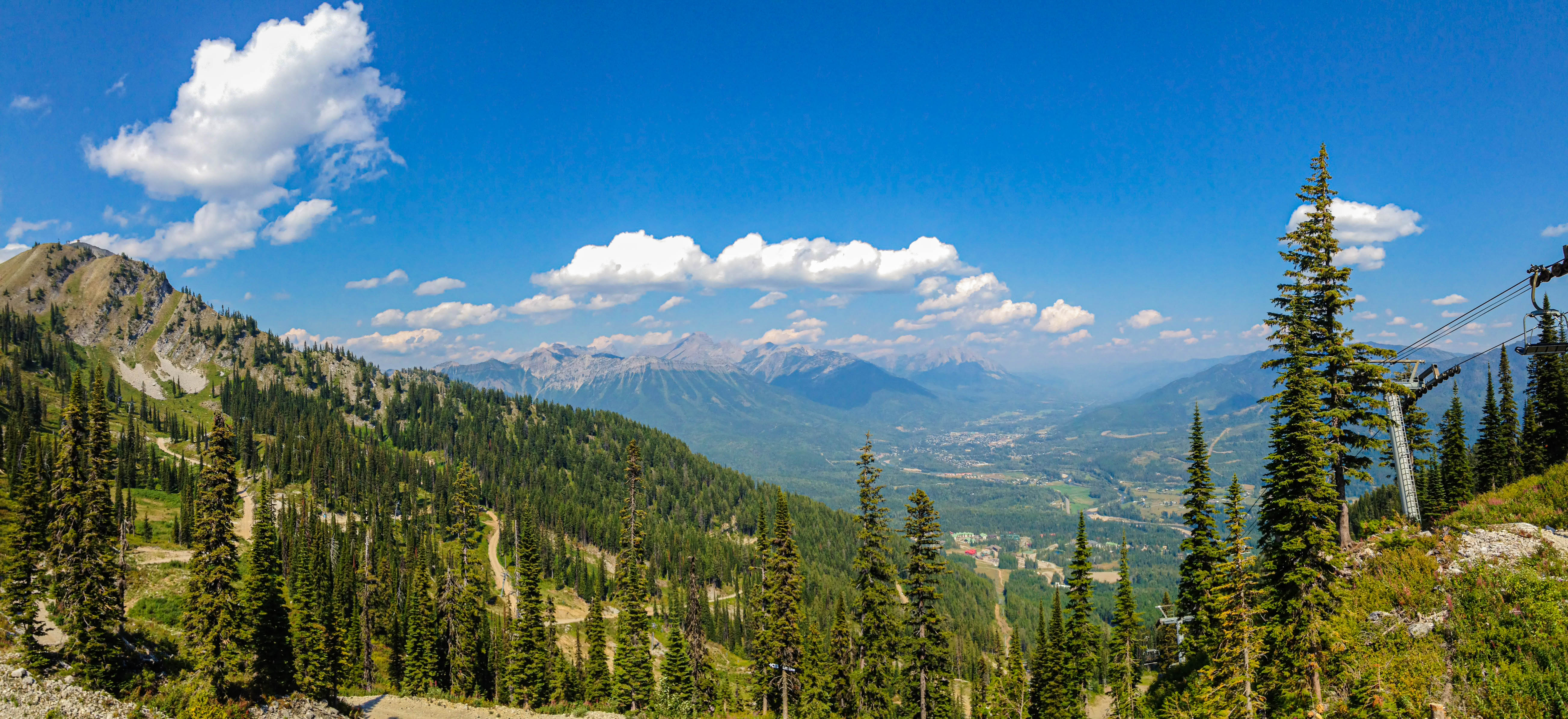
Fernie

So what’s Fernie like for the other nine months of the year?

I’ve lived and worked here long enough to answer that question honestly. This isn’t a marketing piece about how Fernie has it all. It’s a practical look at what day-to-day life actually looks like for the people who move here and stay - the families, the remote workers, the professionals who decided life in a smaller, more beautiful place, was worth trading for whatever they left behind.

A Four Season Town

Fernie is called a "ski town" because ski season is what first attracts people. But residents know there are four genuinely distinct seasons, each with their own character.

Winter is what it looks like in the brochure: the resort and town filling up surrounded by snow capped scenery. Ski season runs from end-November to mid-April, and it’s legitimately world-class. The resort averages around 30 feet of snowfall per year. When it’s on, there’s nowhere that compares.

Spring is a transition season, and by mid-May the valley is stunning. The Elk River runs full and cold, and things green up fast at this elevation.

Summer is when Fernie becomes a different place entirely. Town is full of bikers heading out on our extensive trail system. Hikers head to Mount Fernie Provincial Park, or up to Island Lake. Families float on the Elk River, enjoy the weekly farmers market, and the sunny patio scene on 2nd Avenue. This is the version of Fernie that turns visitors into permanent residents.

Fall is short and spectacular: golden larch season is spectacular in the valley, the mornings are crisp, the trails are quieter, and there's a slow buzz as we build back toward ski season. Many locals will tell you it’s their favourite time of year.

Schools: More Choice Than You'd Expect

This is usually the first question from families considering a move, and it’s worth being direct about.

Fernie has a very well established school system. Isabella Dicken Elementary runs K–6 with a strong community feel, a gym, and outdoor fields. Fernie Secondary School (grades 7–12) offers a full academic program plus electives in arts, shops, and applied skills. It’s a small school by city standards, which means teachers actually know your kids.

The Fernie Academy offers a private K–12 option with an academically driven morning program and a strong emphasis on outdoor and cultural pursuits in the afternoons. It's a genuinely interesting model for families who want something different.

L’école Sophie-Morigeau provides for French immersion students, and a new elementary school is currently under development (slated to open in 2027), which speaks to the growth the city is planning for.

The honest caveat: if you’re coming from a large urban centre, transitioning requires thought. But for most families, the trade-off looks like this: smaller classes, outdoor-integrated education, and a community where your kids grow up knowing their neighbours.

Healthcare and Services

The Fernie District Hospital on 2nd Avenue provides emergency services, there are general practitioners, and coverage for most essential care. Specialist treatment requires travel, usually to Cranbrook or Kelowna. That’s the reality of living in a small mountain city in BC.

The town has dentists, pharmacies, physiotherapists, chiropractors and all the everyday services you’d expect. For routine life, you’re well covered. For anything complex, you try to plan ahead.

A Real Community

This is where Fernie genuinely surprises people. It’s a real town with a real community, not a resort village.

2nd Avenue is a proper main street with numerous boutique stores, brunch places, coffee shops, bakeries and pubs. We have every base covered for foodies: tapas, Japanese, Italian, Mexican, a steakhouse, a distillery and Fernie Brewing Co, whose taproom is a local post-ride institution.

There’s a proper bookshop and a fantastic library. The Fernie Memorial Arena is a real community anchor with hockey, curling, and public skate running through the winter. There's a municipal aquatic centre with two pools and a waterslide. The historic Vogue Theatre on 2nd Avenue has two movie screens.

The Farmers Market runs throughout summer and early fall in Rotary Park. It’s the social event of the week with local produce, handmade goods, kids running around, familiar faces. If you want to understand what community rhythm means in a town this size, head to the weekly Wednesday Social at Station Square for live music, a beer garden and food trucks.

None of this is written to oversell it. By city standards, Fernie is small. You will have to drive to Cranbrook for certain things. You will not have a Costco or a specialty medical centre within an hour's drive. What you will have is a town where you know your neighbours, your kids walk to school, and the grocery run takes fifteen minutes longer because you run into three people you know along the way.

The Commute Question

Many buyers I talk to are planning to be remote workers or considering a career change. For them, working from home in Fernie can be a viable option.

For people who need regular in-person presence somewhere: Calgary is roughly three hours away, Vancouver and Kelowna are a quick hop from Cranbrook airport. If your work requires frequent urban travel, that’s worth considering honestly before you buy.

What I often see is people who’ve restructured their work life around the move: working remote, shifting to consulting, or retiring earlier than planned. Fernie has a way of making that recalculation feel worth it.

Weighing It All Up

Not everyone who buys in Fernie lives in Fernie. Some people buy a vacation property and use it on weekend and holidays, and there's nothing wrong with that.

However the people who move here full-time, and don’t look back, tend to share a few things. They’re not just escaping something, they’re moving toward a specific vision of daily life. They want their kids outside more than they’re inside. They care about community in a way that’s hard to find in a neighbourhood of 50,000 people. They’ve made peace with the trade-offs on urban amenities, and they see the size of Fernie as an attraction rather than a limitation.

They’ve also done their research. They’ve visited more than once. They’ve come in November, not just February. They’ve walked main street on a wet Tuesday morning and watched what happens.

And if it's still calling out to you then, filling your head with visions of a lifestyle that you really want, Fernie will welcome you.

Reach out any time: 778-745-0347 or phil@philgadd.com


ABOUT THE AUTHOR

Phil Gadd is the owner of First Tracks Real Estate Group, operating under eXp Realty in Fernie, BC. With deep local knowledge and a client-first approach, Phil helps buyers and sellers across Fernie, Sparwood, Jaffray, and Lake Koocanusa find their perfect mountain property. 72 five-star Google reviews.  livinginfernie.com |  778-745-0347