Most relocation calls eventually get to the same question: Is there actually work in Fernie, or is it just somewhere people visit on vacation?
It is a fair question, and one that tourism and real estate websites rarely answer. They will tell you about the powder and the mountain views, but not much about the local economy or how people make a living once they move here.
Fernie is not simply a resort town supported by seasonal wages. It sits within one of the strongest industrial economies in rural British Columbia. The catch is that much of the higher-paying work is outside Fernie itself.
The Valley Runs on Coal, and That Matters More Than the Mountain
There are four steelmaking coal mines in the Elk Valley, now operating as Elk Valley Resources (EVR) under Glencore. Roughly 5,500 people work across those operations.
Compare that with Fernie’s population of around 5,500 and you quickly see how important mining is to the valley.
These are year-round jobs with union wages, benefits and, for many qualified tradespeople and equipment operators, six-figure incomes. The industry supports families throughout Fernie, Sparwood, Jaffray and Elkford, as well as many local contractors, suppliers and small businesses.
It also gives the valley more economic stability than a mountain town relying entirely on tourism.
Mining is still a commodity business, however. Coal prices respond to global steel demand, and employment levels can change with the market, for example in June 2025, Elk Valley Resources cut 140 staff positions, citing market conditions.
The mines have decades of permitted reserves ahead of them, so there is no sense that the industry is about to disappear. But the cycle is real. If your household depends on one mine income, don't borrow to the very top of your approval, consider leaving yourself some breathing room.
The Mountain Is an Employer, Just Not the One You Think
Fernie Alpine Resort employs hundreds of people during the winter. Around it sits the rest of the visitor economy, including hotels, restaurants, rental shops, guiding companies, property managers and cleaning businesses.
This work is essential to Fernie, but many entry-level tourism jobs will not comfortably carry a Fernie mortgage on their own.
The seasonality can also surprise newcomers. The shoulder seasons are quieter, they generate less money, while normal household expenses continue.
Tourism income often works best as the second income in a household, as an entry point for someone new to the valley, or as the foundation for a local business.
Some of the most comfortable people I know in Fernie own small businesses connected to tourism, construction, property services, or recreation. They found their place in the local economy, built a good reputation and became part of the community.
The Quiet Third Economy
Health care, education and local government employ a large number of people throughout the Elk Valley.
Interior Health, School District 5, the City of Fernie, the emergency services, provincial services and local community organizations all provide year-round employment.
These jobs may be less visible than the mines or ski hill, but they are an important part of the local economy. Many also offer stability, benefits and pensions.
The challenge is often finding enough qualified people.
Nurses, LPNs, teachers, early childhood educators, mechanics and other skilled workers are regularly needed throughout the valley. That does not mean every role will be available immediately, but the demand is real.
For relocating couples, this can work well. One person may arrive with a confirmed job while the other has a good chance of finding suitable work locally.
If You Hold a Trade Ticket, Read This Part Twice
The Elk Valley needs tradespeople.
The mines, construction companies, contractors and homeowners are all competing for plumbers, electricians, framers, equipment operators, HVAC technicians and mechanics.
The mines often win on wages and benefits, leaving the residential and service sectors short of people.
I see the result constantly. Getting a roof quoted, a furnace replaced or a renovation completed can take longer here than it would in Calgary.
That is frustrating when you need the work done. It is a strong opportunity if you are the person qualified to do it.
Many people accept a lower income to live in Fernie. Skilled tradespeople may be able to improve both their income and their lifestyle.
There is work at the mines, but there is also room to build a strong independent business. Tradespeople who communicate clearly, show up and do good work can build a great local reputation quickly.
In a small town, word gets around.
Working Remotely: Better Than You Expect, With One Catch
Fernie has reliable high-speed internet, including Telus fibre in much of the community. I run a business here using cloud software and video calls every day. Connectivity is rarely the issue people expect it to be.
Fernie is also on Mountain Time, the same as Calgary and one hour ahead of Vancouver. That works well for people dealing with clients and colleagues remotely.
The bigger risk is whether your job stays remote.
Company policies change. Managers change. Businesses restructure. Employees who were told they could work from anywhere are sometimes asked to return to an office.
I have worked with several buyers who moved here with fully remote jobs and later faced that decision. Two changed jobs and stayed. One sold the house.
That is not a reason to avoid moving here. It is a reason to have a backup plan.
Before buying, ask what would happen if your role changed. Could you find similar work? Could your household manage on one income for a while? Would the mortgage still feel comfortable if you earned less?
Those are much easier questions to answer before the purchase.
The Commute Nobody Puts in the Brochure
Many people live in Fernie commute to work for EVR in Sparwood or Elkford.
In summer, the drive can feel easy. However during a twelve-hour shift rotation in December, you may travel both ways in the dark, with snow, wildlife and winter road conditions adding time.
Plenty of people make the commute for years while raising families in Fernie. For many, the income and shift schedule make it worthwhile. But it does shape your week.
A twelve-hour shift becomes longer once you include the drive, meals and getting ready for the next day. During a run of shifts, there may be little time at home beyond eating and sleeping.
If you plan to live in Fernie and work farther up the valley, drive the route in winter before choosing a home. A January morning will tell you more than a July afternoon.
What All of This Should Change About Your Purchase
A household with one mining income and one public-sector income is generally on solid financial ground in the Elk Valley.
A household stretching one cyclical income to the full limit of a mortgage approval is in a different position.
Both may be able to buy a home, but they should not necessarily buy the same home or carry the same payment.
A mortgage approval tells you what a lender is prepared to provide based on your current situation. It does not tell you what will still feel manageable after a job change, parental leave, slower season or unexpected expense.
If your income comes from remote work, a business elsewhere or a pension, the better question may not be how much you can borrow. It may be what payment would still feel comfortable if your circumstances changed.
And if you are moving here to work in a trade or start a business, location matters. Being close to town, customers and suppliers may be more valuable than gaining extra square footage fifteen minutes away.
Fernie is a working town with a world-class ski hill attached to it, not a ski resort trying to create a year-round economy.
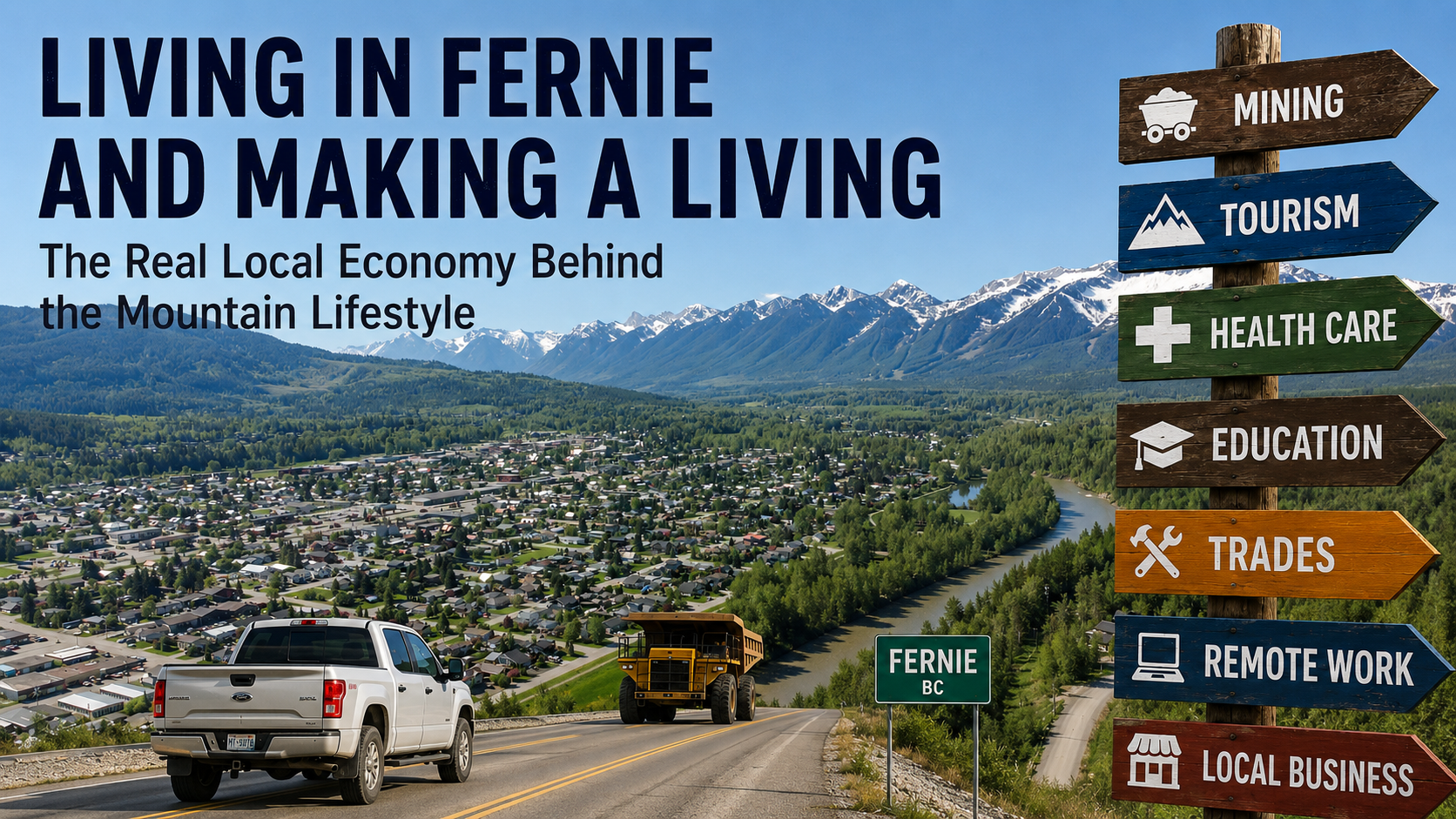
People raise families, run businesses and retire here on income from mining, health care, education, trades, tourism, remote work and local businesses.
Relocations tend to become difficult when people arrive without understanding where their household fits into that economy.
The moves I have seen work best involved people who knew where their income would come from, left room in the budget and had a backup plan if something changed.
That matters far more than finding the house with the perfect view.
If you are considering a move to Fernie and want to talk through employment and income before getting too deep into the house search, call or text me at (778) 745-0347 or email phil@philgadd.com.
Phil Gadd is the owner of First Tracks Real Estate Group, operating under eXp Realty in Fernie, BC. With deep local knowledge and a client-first approach, Phil helps buyers and sellers across Fernie, Sparwood, Jaffray, and Lake Koocanusa find their perfect mountain property. 72 five-star Google reviews. livinginfernie.com | 778-745-0347